Puppy weaning schedule: safe transition at 3 to 8 weeks
Last reviewed: 2026-07-09 · General information only.
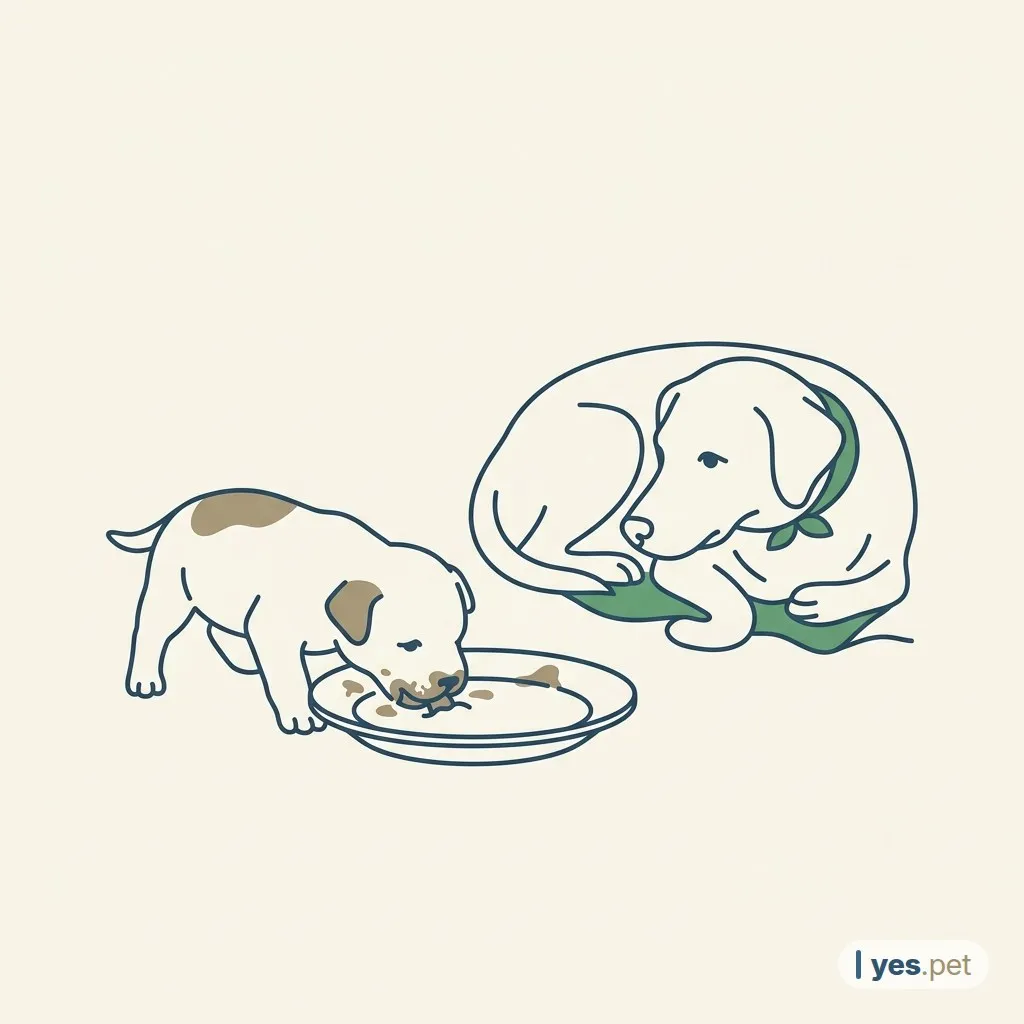
Weaning is the few weeks when a litter trades mum's milk for solid food. For a healthy litter still with its mother, it's a normal, slightly messy milestone — not a medical project — and this is a calm, step-by-step guide to those weeks, roughly three to eight. But if your puppy is orphaned, much younger than this, or unwell, the kindest and safest move is a vet or a rescue rather than a schedule, and we'll say so plainly below. General orientation only; your veterinarian knows your puppy best.
Is this guide right for your puppy? Read this first
Weaning is the short stretch when a litter shifts from mum's milk to solid food — usually a normal, messy, rewarding milestone. This guide is for a healthy litter that is still with its mother, roughly three to eight weeks old, where you are helping introduce food alongside nursing.
If instead your puppy is orphaned or without its mother, looks younger than about three to four weeks, isn't gaining weight, feels cold, is weak or limp, won't eat, or has diarrhoea — please stop here and call a veterinarian or a local rescue now. Very young and unwell puppies can fade fast, and they need hands-on help, not a checklist. It isn't an overreaction; it's the responsible move, and there is more on it below.
Warmth and hydration come before the next meal
With a young litter, warmth and water matter even before food. A chilled puppy can't digest a meal properly, and small puppies dehydrate quickly, so keep them somewhere warm and free of draughts with their mother and littermates close.
Dry or tacky gums, or skin that stays 'tented' for a moment when gently lifted, can be signs of dehydration — and a puppy that is cold, floppy, or fading is an emergency. That's the moment to call a vet straight away, rather than trying to feed it through it on your own.
When do puppies start weaning?
Weaning isn't a single day; it's a gradual handover from milk to solid food that follows the puppies' own development, and it tends to begin once their first teeth appear.
VCA Animal Hospitals advises that weaning "should begin at three to four weeks of age," with puppies starting on softened solid food over the weeks that follow. [src]
Early on, the mother's milk is still doing important work, so weaning runs alongside nursing rather than replacing it overnight — and most puppies are fully weaned by around eight weeks, the age they typically go to new homes.
Week by week: feeding from 3 to 8 weeks
Here is the usual shape of it for a healthy litter with its mother. Take these ages as rough guides — puppies vary, and yours may move a little faster or slower.
The AKC describes starting gruel by soaking ground puppy food until it is "watery and messy (mushy like cream of wheat)," offered in a shallow dish. [src]
From there the mush thickens each week: soaked, mashed kibble is mixed in, the extra liquid is gradually reduced, and by around eight weeks most puppies are managing crunchy puppy food. The table below sums it up.
Warning signs — when to call the vet now
Weaning is usually uneventful, but a few signs mean it's time to stop and get a vet rather than push on:
a puppy not gaining weight, or losing it; one that feels cold, or is weak, floppy or unusually quiet; any puppy that refuses to eat or drink; vomiting or diarrhoea; or a puppy that seems to be 'fading' while its littermates thrive. When in doubt, it is always reasonable to phone — vets would far rather hear from you early than late.
How do I make and offer puppy gruel?
Gruel is simply puppy food softened into something a wobbly mouth can manage: soaked puppy kibble or wet puppy food, blended with warm water (or a puppy milk replacer) into a smooth, lump-free mush. Offer it warm in a flat, shallow saucer the puppies can walk up to and lap from, and many people start by letting a puppy lick a little off a finger.
Two safety notes worth repeating. Use a milk replacer made for puppies, never cow's milk, which isn't a suitable substitute. And never make the gruel thin and watery or feed it with a syringe — a puppy can breathe the liquid in, which is dangerous; a shallow dish lets them lap at their own pace instead.
VCA Animal Hospitals notes cow's milk is not an equivalent: it is "lower in calories, fat, and other minerals, but higher in carbohydrates, including lactose," which is why a puppy milk replacer is used in its place. [src]
If a puppy isn't interested at first, that's common — warm the gruel to just above room temperature, dab a little on its lips or your finger, and give it time. If a puppy keeps refusing food, that on its own is a reason to call your vet.
How often should a weaning puppy eat?
Little and often is the rule while they are small — think several small meals spread through the day.
VCA Animal Hospitals suggests feeding very young puppies often — on the order of every six to eight hours — alongside whatever they are still nursing. [src]
Keep the meals at roughly the same times, put the dish down for fifteen to twenty minutes, then take it up. It keeps the food fresh and lets you see who is eating well. Your vet can confirm the right amounts for your particular litter.
What if the puppy is orphaned or bottle-fed?
This is the part to take seriously. A puppy without its mother — especially a newborn — is not just a smaller version of the weaning litter above. It needs specialised, hands-on care, and the safest thing you can do is get a veterinarian or an established rescue involved straight away.
To give a sense of why: a newborn can't keep itself warm, can't yet toilet without help, and needs specialised feeding and care around the clock — and small mistakes with warmth, feeding or formula carry a high cost, fast. It's a lot to get right, and it isn't something to improvise from a web page.
VCA Animal Hospitals advises that a veterinarian be consulted for orphaned puppies — including for alternative feeding methods for weak puppies, tube feeding, and instruction on stimulating elimination. [src]
So if that is your situation, please don't try to piece it together from a schedule. Call a vet or a local rescue today — many will talk you through it or take the puppies in. There is no shame in handing this to people who do it every day.
When is weaning finished — and what's next?
By around eight weeks, most healthy puppies are eating solid puppy food and no longer relying on milk — weaning done. From there the question changes from 'how do I start solids' to 'how often and how much,' and the routine settles into a few meals a day.
Our companion guides pick up exactly there: the puppy feeding schedule by age (meals per day from about eight weeks onward) and how much to feed a puppy (portions and body condition).
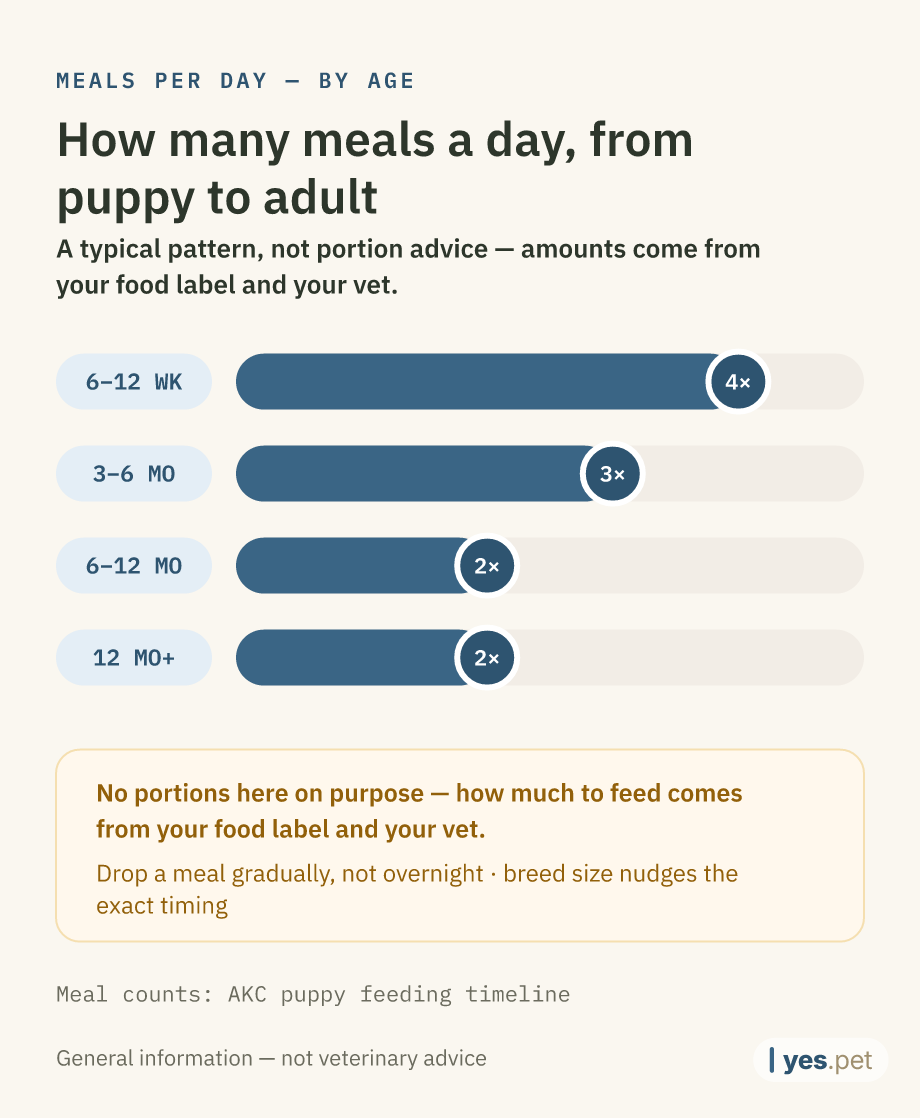
Typical meals per day by age — fewer, larger meals as a puppy grows. Amounts come from your food label and your vet.
Meal counts: AKC puppy feeding timeline
Puppy weaning at a glance (orientation only — a healthy litter with its mother)
| Age | Main food | Milk's role | Texture |
|---|---|---|---|
| 3–4 weeks | Start gruel, alongside nursing | Most nutrition still from milk | Soupy, like cream of wheat |
| 4–5 weeks | Gruel plus mashed soaked kibble | Milk decreasing | Thick mush |
| 5–6 weeks | Mostly soaked kibble | Minimal milk | Soft, less liquid |
| 6–8 weeks | Softened, then dry puppy food | Usually weaned | Crunchy by about 8 weeks |
Key takeaway
For a healthy litter with its mother, weaning runs from about three to eight weeks: start warm, smooth gruel around 3–4 weeks, thicken it week by week, offer several small meals a day, and let the puppies move onto solid food by eight weeks. Keep them warm, never use cow's milk, and never feed thin gruel by syringe. And if a puppy is orphaned, very young, or unwell, skip the schedule and call a vet or rescue today.
Turn this advice into a schedule →
Related guides
Frequently asked questions
How often should I feed a 4-week-old puppy?
While weaning, little and often is the rule — VCA Animal Hospitals suggests feeding very young puppies roughly every six to eight hours (about three to four small meals a day), alongside any nursing. Keep to steady times and ask your vet to confirm amounts for your litter. If the puppy is orphaned or unwell, call a vet rather than following a schedule.
Can a 5-week-old puppy eat dry food?
Not dry-dry yet. Around five to six weeks, puppies do best on kibble softened with warm water (or wet puppy food) and mashed. The water is reduced over the following weeks until they manage crunchy food by about eight weeks.
What do I feed a weaning puppy — and can I use cow's milk?
Puppy food softened into a smooth gruel — soaked kibble or wet puppy food blended with warm water or a puppy milk replacer. Don't use cow's milk; it isn't a suitable substitute. Offer it warm in a shallow saucer, never thin and watery or by syringe.
What should I do with an orphaned newborn puppy?
Call a veterinarian or a local rescue today. Orphaned and newborn puppies can't keep themselves warm or toilet on their own and need specialised round-the-clock care, where small mistakes carry a high cost — so it's best done with hands-on guidance, not improvised from a web page. Many vets and rescues will talk you through it or take the puppies in.
Is this a substitute for veterinary advice?
No. yes.pet provides general information only and is not a substitute for professional veterinary advice, diagnosis or treatment. Always consult your veterinarian.
Sources
- Closing the Milk Bar: The Puppy Weaning Process (opens in a new tab) — American Kennel Club (AKC)
- Raising Puppies (opens in a new tab) — VCA Animal Hospitals
- Feeding Orphaned Puppies (opens in a new tab) — VCA Animal Hospitals