Puppy feeding schedule by age — meals per day from 8 weeks to 1 year
Last reviewed: 2026-08-20 · General information only.
Puppies eat little and often, then grow into a steadier rhythm. A typical puppy feeding schedule involves four small meals a day for a young puppy, three from around three to six months, and two from roughly six to twelve months — with breed size nudging the exact timing and spacing. Treat the schedule below as a starting map, not a rulebook: every puppy is different, and your veterinarian knows yours best.
Puppy feeding schedule by age: how many meals a day?
Puppies need to eat more often than adult dogs, and the number of meals steps down as they grow — not all at once, but in a few clear stages.
The American Kennel Club's general timeline: at 6 to 12 weeks, "Four feedings a day are usually adequate to meet nutritional demands"; at 3 to 6 months, "Sometime during this period, decrease feedings from four to three a day"; and at 6 to 12 months, "Begin feeding your puppy twice daily." [src]
Keeping those meals at consistent times does more than feed your puppy. A steady routine also makes potty trips easier to predict — what goes in on a schedule tends to come out on one.
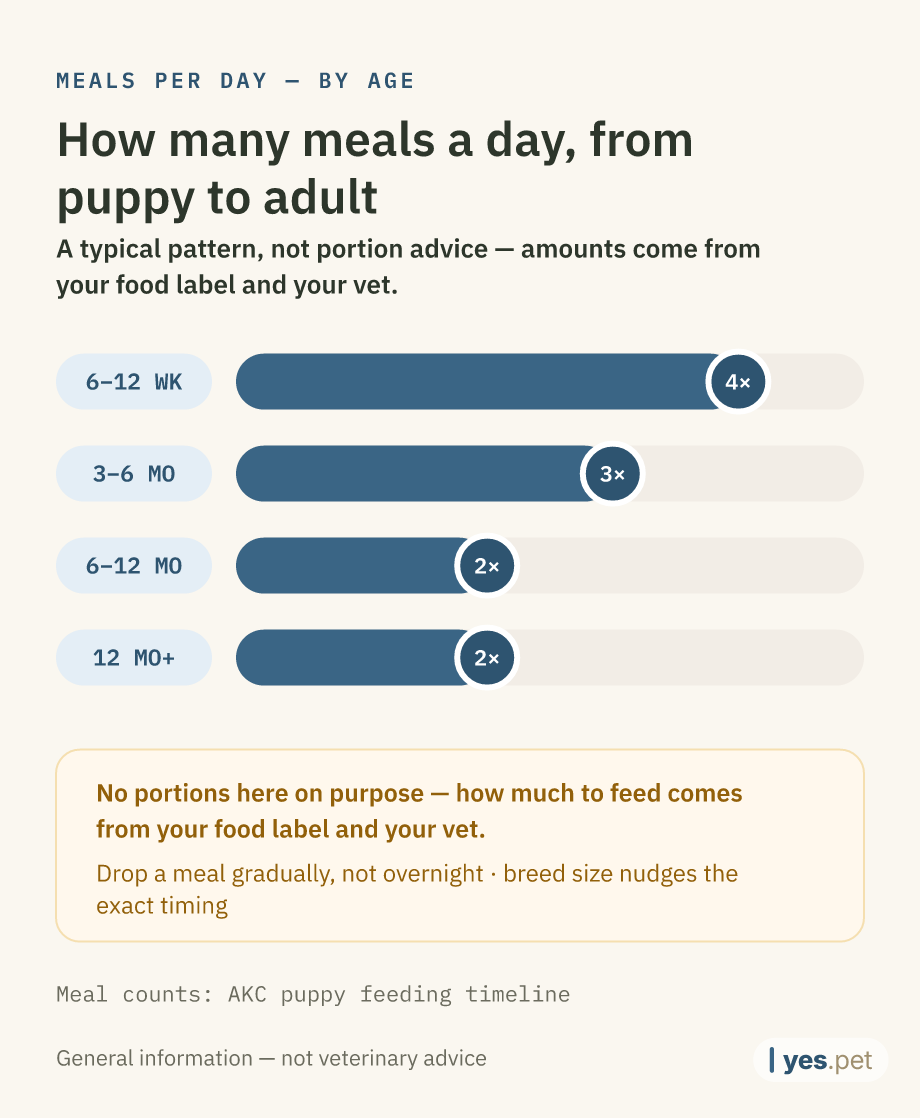
Typical meals per day by age — fewer, larger meals as a puppy grows. Amounts come from your food label and your vet.
Meal counts: AKC puppy feeding timeline
How far apart should puppy meals be?
Meal count is only half the picture — spacing matters, too. Puppies burn through energy much faster than adult dogs, so their meals belong spread evenly across their waking hours rather than bunched together, avoiding long stretches on an empty stomach.
As a general guideline, not a fixed rule: space the day's meals evenly around your own routine — morning, midday, and evening for three meals, or morning and evening for two. Using a tool like the free Puppy Feeding Calendar makes it easy to log your actual feeding times and maintain consistent spacing from day to day.
Why do puppies eat so often?
A young puppy has a small stomach but a big appetite for growth, so it simply can't take in a whole day's energy in one or two sittings. Spreading food across several small meals keeps energy steadier through the day and is gentler on a developing digestive system.
This is also why very small and toy-breed puppies often do best with meals spread evenly from morning to night — they have little reserve to coast on between meals. If your puppy is tiny, your vet can tell you whether it needs that closer spacing.
How does breed size change the timing?
Small and large breeds grow on different clocks, so the points where you drop a meal — and eventually move to adult food — shift with size.
The AKC notes the switch to adult food differs by size: "Small breed puppies can make the switch to adult food at 7 to 9 months," while larger breeds may wait until "12, 13, even 14 months." [src]
It also advises caution on the timing of that switch: "Err on the side of caution: Better to be on puppy food a little too long than not long enough." [src]
Should I leave food out or feed set meals?
There are two common approaches. Free-feeding leaves food available all day; scheduled feeding offers measured meals at fixed times and takes the bowl up in between.
For most puppies, set meals are the easier choice. They let you see exactly how much your puppy eats — a quiet early signal if appetite dips — they keep portions in check, and, handily for house-training, they turn meals into predictable anchors for potty trips. Free-feeding suits some situations, but it makes both portion control and potty timing harder to read.
VCA Animal Hospitals cautions that unlimited access to food — "ad libitum" or "free choice" feeding — "is not recommended, as it can create juvenile obesity, encourage binge-eating, and lead to orthopedic problems and diabetes." [src]
When should I check with a vet?
This is general information, not a health check. Lean on your veterinarian to confirm the right food and meal count for your puppy's breed and stage of growth.
And reach out sooner rather than later if your puppy turns away from food, suddenly seems far hungrier or thirstier than usual, or is gaining or losing weight unexpectedly. A vet's plan for your specific puppy always overrides any general schedule.
Puppy feeding chart: common meals-per-day pattern by age (orientation only)
| Puppy age | Meals per day (common) | Note |
|---|---|---|
| 6–12 weeks | 4 | Small, frequent meals while growth needs are highest |
| 3–6 months | 3 | Drop from four to three somewhere in this window |
| 6–12 months | 2 | Settle into twice-daily feeding |
| Around 1 year | 2 | Most dogs stay on two meals a day as adults |
Key takeaway
Plan on about four meals a day for a young puppy, three from three to six months and two from six to twelve — keep them at steady times, and let breed size and your veterinarian fine-tune when to drop a meal and switch to adult food. For portion sizes, treats and changing foods, see the companion guide on how much to feed a puppy.
Turn this advice into a schedule →
Related guides
Frequently asked questions
How many meals a day should a puppy eat by age?
A common pattern is four meals a day at 6–12 weeks, three meals from around 3–6 months, and twice daily from about 6–12 months. Exact timing varies with breed size, so confirm the food and portions with your vet.
When does a puppy switch to adult food?
It varies by breed size: smaller breeds often switch around 7 to 9 months, while larger breeds may wait until about 12 to 14 months. When in doubt, the cautious choice is to stay on puppy food a little longer and ask your vet.
Should I free-feed my puppy or give set meals?
For most puppies, set meals are the easier choice. Measured meals at fixed times keep portions in check, show you quickly if appetite dips, and give house-training predictable anchors. Free-feeding (leaving food out all day) can work in some cases but makes both portion control and potty timing harder to read. Ask your vet what suits your puppy.
Is there a puppy feeding chart I can use?
The table above is a general puppy feeding chart showing a meals-per-day pattern by age. For a version built around your puppy's birthday and feeding times, the free Puppy Feeding Calendar turns these stages into day-by-day reminders. Treat both as starting points, and confirm portions and timing with your vet.
Is this a substitute for veterinary advice?
No. yes.pet provides general information only and is not a substitute for professional veterinary advice, diagnosis or treatment. Always consult your veterinarian.
Sources
- Puppy Feeding Fundamentals: Timeline for Puppy Feeding (opens in a new tab) — American Kennel Club (AKC)
- Feeding Times and Frequency for Your Dog (opens in a new tab) — VCA Animal Hospitals