How much to feed a puppy: portions, treats & diet changes
Last reviewed: 2026-07-09 · General information only.
Knowing how often to feed a puppy is only half the picture — the other half is how much. The right amount depends on your puppy's weight, age and how it's actually growing, and a few small habits keep the daily total in balance: count the treats, and change foods slowly. As always, this is general orientation — your veterinarian sets the final amounts for your dog.
How much should each meal be?
Start with the feeding chart on your puppy's food. Those amounts are set by current weight and age and split neatly across the day's meals — a sensible starting point rather than a final verdict.
From there, let your puppy's body do the fine-tuning. As a rough guide, you should be able to feel the ribs easily with light pressure — under a thin layer, neither buried nor sticking out — and see a gentle waist from above. If the ribs are disappearing under fat, ease back a little; if they feel sharp, add a little. Growth is fast and appetites shift week to week, so re-check now and then — and let your vet confirm the right amount for your puppy.
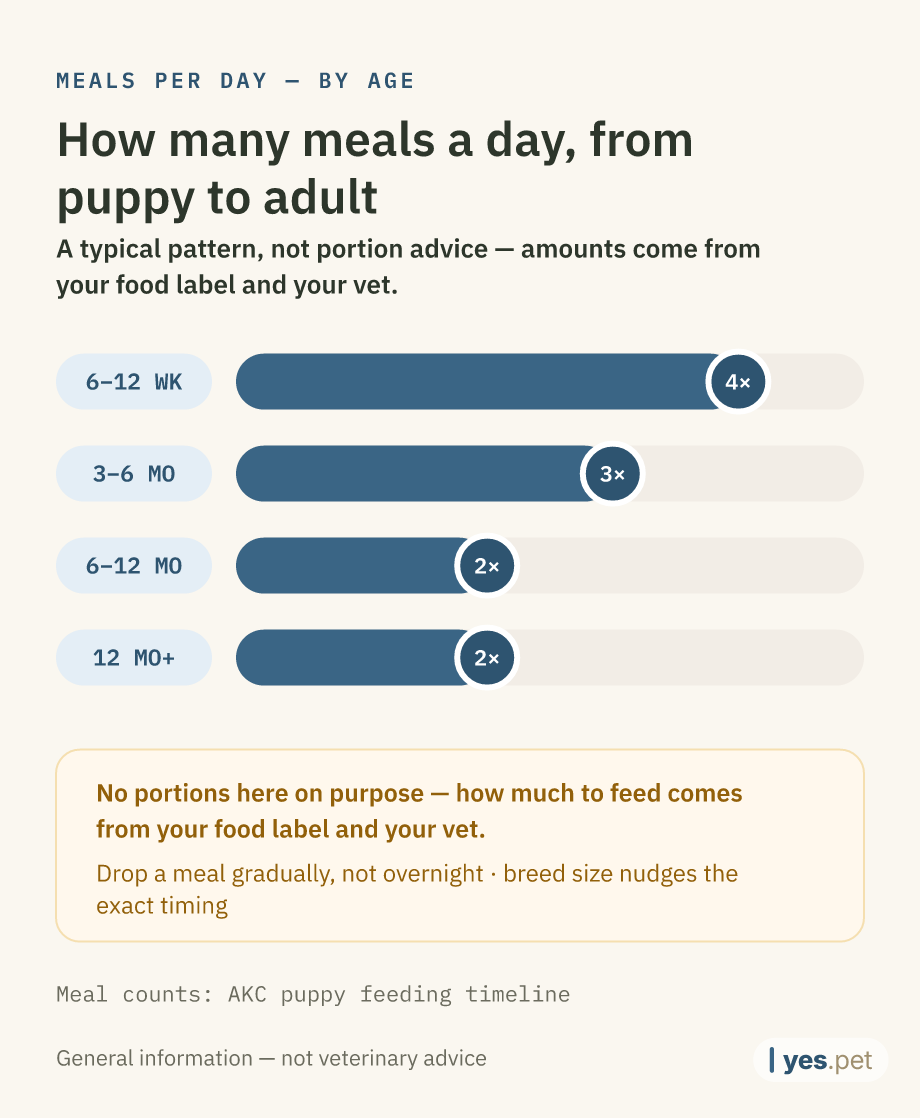
Typical meals per day by age — fewer, larger meals as a puppy grows. Amounts come from your food label and your vet.
Meal counts: AKC puppy feeding timeline
How do I read my puppy's body condition?
Body condition is the everyday check that keeps portions honest, and it takes only a few seconds with your hands and eyes. Press your fingertips gently over the ribs, then look down at your puppy from above and from the side.
The quick guide below shows what usually goes with too little, about right, and too much food. Coats and puppy fluff can hide a lot, so trust your hands over your eyes — and remember a growing puppy looks a little leaner than a settled adult.
Where do treats fit in?
Treats add up faster than most owners expect, especially during training, so the trick is to fit them inside the day's food rather than piling them on top.
The AKC echoes the common veterinary guideline that "treats should not make up more than 10 percent of your dog's total diet." [src]
In practice, count treats as part of the daily total and trim the next meal a touch on a heavy training day. Small, low-calorie pieces — even a few bits of the regular kibble set aside — stretch a session without tipping the balance.
How do I switch my puppy's food gradually?
Whether you're changing brands or graduating from puppy to adult food, a gradual swap over about a week gives the digestive system time to adjust.
The AKC suggests a roughly 7-day transition by mixing old and new food: "Day 1: 25% new diet and 75% old diet. Day 3: 50% new diet and 50% old diet. Day 5: 75% new diet and 25% old diet. Day 7: 100% new diet." [src]
Keep an eye on appetite and stools as you go, and stretch the change out if your puppy seems unsettled — some need a slower, gentler transition. When in doubt, ask your vet.
When should I check with a vet?
This is general information, not a health check. Lean on your veterinarian to confirm the right food and portion size for your puppy's breed and stage of growth — especially for large and giant breeds, where growth rate matters.
And reach out sooner rather than later if your puppy turns away from food, suddenly seems far hungrier or thirstier than usual, or is gaining or losing weight unexpectedly. A vet's plan for your specific puppy always overrides any chart.
Body condition at a glance (orientation only)
| Body condition | Ribs (by feel) | Waist (from above) | Tummy tuck (from the side) |
|---|---|---|---|
| Likely too little | Sharp and very easy to see | Very pronounced, narrow | Deeply tucked up |
| About right | Easy to feel with light pressure | Visible, gentle curve | Slight upward tuck |
| Likely too much | Hard to feel under a layer | Little or none | Flat, no tuck |
Key takeaway
Treat the bag's feeding chart as a starting point, then adjust to your puppy's body — ribs easy to feel, a gentle waist from above. Keep treats inside the daily total, switch foods gradually over about a week, and let your veterinarian confirm the right amount. For how many meals a day at each age, see the companion guide to the puppy feeding schedule by age.
Turn this advice into a schedule →
Related guides
Frequently asked questions
How much should I feed my puppy?
Start from the feeding chart on the food, which is based on current weight and age, then adjust to body condition: you should be able to feel the ribs easily with light pressure and see a slight waist from above. Re-check as your puppy grows, and let your vet confirm the amount.
How do I know if I'm feeding too much or too little?
Use body condition. If the ribs are sharp and very easy to see and the waist looks pinched, your puppy may need a little more; if the ribs are hard to feel under a layer and there's no waist, ease back. Trust your hands over your eyes, and ask your vet if you're unsure.
How much of a puppy's food can be treats?
A common veterinary guideline, echoed by the AKC, is that treats should not make up more than 10 percent of a dog's total diet. Count treats inside the daily total rather than adding them on top — trim the next meal a little on a heavy training day. Ask your vet about your puppy's portions.
How do I change my puppy's food gradually?
Switch over about a week. The AKC suggests roughly: Day 1 a 25%-new / 75%-old mix, Day 3 a 50/50 mix, Day 5 a 75%-new / 25%-old mix, and Day 7 fully on the new food. Watch appetite and stools, slow down if needed, and ask your vet if anything worries you.
Is this a substitute for veterinary advice?
No. yes.pet provides general information only and is not a substitute for professional veterinary advice, diagnosis or treatment. Always consult your veterinarian.
Sources
- How Many Treats Can Your Dog Really Have? (opens in a new tab) — American Kennel Club (AKC)
- How to Switch Dog Foods: Transitioning Your Dog's Diet (opens in a new tab) — American Kennel Club (AKC)