Walking your dog in hot weather — temperature and pavement safety
Last reviewed: 2026-07-09 · General information only.
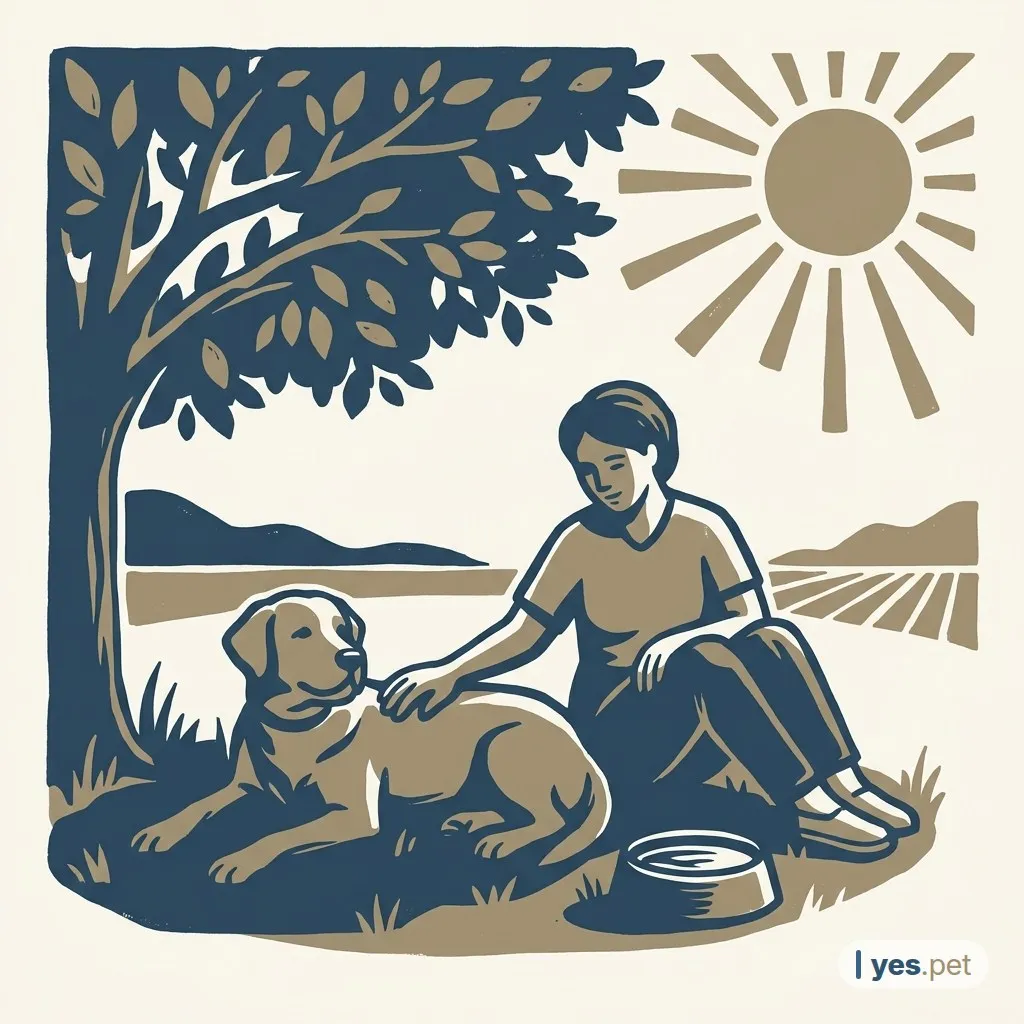
There is no single "safe" air temperature, but a practical answer is to let the ground and the cooler parts of the day decide. If you cannot hold the back of your hand on the pavement for about ten seconds, it is too hot to walk. On warm, humid days the safest plan is an early-morning or evening walk on grass and shade — or skipping the walk and doing something calm indoors. This is general orientation only; your dog's age, breed and health change the picture, and your veterinarian knows yours best.
What is the short answer?
Judge the walk by the ground and the time of day, not by a single number on the thermometer. The simplest objective check is the hand test on the surface you are about to walk on.
Cornell University's Riney Canine Health Center advises: "If you cannot put your own hand or stand barefoot on the pavement for about 10 seconds, then it is likely too hot." [src]
If the ground passes that test, still favour shade, grass and the cooler parts of the day, carry water, and shorten or skip the outing for dogs that struggle in heat. When in doubt, a calm activity indoors beats a risky walk.
How can I tell if it is too hot to walk?
Air temperature alone is misleading because dark surfaces get far hotter than the air above them — so a mild-feeling afternoon can still have ground that burns paw pads.
The American Kennel Club notes that "when the air temperature is 86°F / 30°C, the asphalt temperature registers 135°F / 57°C" — and the rule of thumb is simple: "If it's too hot for your hand, it's too hot for your dog's paws." [src]
Their practical advice for hot spells is to "Walk in the early morning or evening" and stick to grassy or shaded routes. [src]
Cornell adds that "Strenuous exercise should be especially avoided during the hottest parts of the day," so save longer or higher-effort walks for cooler hours. [src]
Why is walking in the heat actually risky?
The bigger danger on a hot day is usually not the parked car — it is the walk itself. Dogs cool themselves mainly by panting, which becomes far less effective as heat and humidity rise, and an enthusiastic dog will keep going past the point that is safe.
A 2020 UK study of 905,543 dogs under primary veterinary care found that "Exertional heat-related illness was the predominant trigger (74.2% of events), followed by environmental (12.9%) and vehicular confinement (5.2%)," concluding that "In the UK, exertional heat-related illness affects more dogs, and kills more dogs, than confinement in a hot vehicle." [src]
Fitness is not a safety margin, either: the AKC warns that "Even dogs that are well-conditioned may overheat easily when exercising on hot days." [src]
The takeaway is not to panic about summer, but to treat the walk — not just the car — as the thing to manage when it is hot.
Which dogs are most at risk in the heat?
Every dog can overheat, but some cope with heat much less well and need extra caution or a skipped walk on warm days.
Cornell explains that "Brachycephalic breeds (short-muzzle breeds such as Pugs, Bulldogs, Boston Terriers, Boxers, etc.) cannot pant as efficiently," so they overheat sooner. [src]
The AKC adds that "Overweight or elderly dogs are also significantly more susceptible to overheating," along with dogs that have thick or double coats that trap heat. [src]
If you see these signs, the current veterinary advice is to "cool first, transport second": move your dog into shade and start cooling straight away — pour cold water (cold tap water is ideal, but not ice-cold) over the body, add a breeze from a fan or open windows, and keep cooling on the way to the clinic rather than waiting until you arrive. The faster a dog is cooled, the better the outcome. [src]
What are the warning signs, and when is it an emergency?
Learn the early signs so you can stop, cool down and head home before things escalate — and know that heatstroke is a true emergency.
The AKC lists early signs of overheating as "Frantic or excessive panting, Extreme salivation or thick saliva, Bright-red gums or tongue, Labored breathing, Weakness or inability to stand, Vomiting or diarrhea." [src]
Cornell is blunt about the severity: "Heatstroke is a life-threatening medical emergency that is caused by a marked elevation in body temperature." [src]
If you see these signs, stop the walk, move to shade, offer small amounts of cool water, and contact your veterinarian or an emergency vet straight away. Pour cold water (cold tap water is ideal, but not ice-cold) over the body, and keep cooling on the way to the clinic.
Recovery on the spot is not the all-clear: the AKC advises that "Even if your dog seems to recover after cooling down, a veterinary visit is important to check for internal damage." [src]
When should I talk to a vet?
This is general information, not a health assessment. Treat any suspected heatstroke as an emergency and contact a vet immediately rather than waiting to see if it passes.
Ahead of the warm season it is also worth asking your veterinarian about your own dog — especially if they are a flat-faced breed, very young or old, overweight, or have a heart or breathing condition. Your vet can tell you what level of activity and what conditions are sensible for your dog, and that always overrides any general rule of thumb.
Is it too hot to walk? A quick orientation (not a prescription)
| Signal | What it suggests | Safer plan |
|---|---|---|
| Hand can't rest on the pavement for ~10 seconds | Surface can burn paw pads | Walk on grass/shade or wait for it to cool |
| Hot and humid midday | Panting cools poorly; heat builds fast | Shift the walk to early morning or evening |
| Flat-faced, senior, overweight or thick-coated dog | Overheats sooner than average | Keep it short and shaded, or skip it |
| Puppy in warm weather | May not slow down when it should | Short, gentle, shaded outing with water |
| Heavy panting, bright-red gums, wobbliness | Possible overheating | Stop, cool, offer water, call a vet now |
Key takeaway
There is no magic temperature: let the pavement hand test, the time of day and your dog's own risk factors decide — walk in the cool, carry water, and treat heavy panting or collapse as an emergency that needs a vet.
Turn this advice into a schedule →
Related guides
Frequently asked questions
Is it too hot to walk my dog?
There is no single safe temperature. If you cannot hold your hand on the pavement for about ten seconds it is too hot, and on warm, humid days it is safer to walk in the early morning or evening on grass and shade — or to skip the walk for a calm indoor activity. Flat-faced, senior, overweight and very young dogs need extra caution.
How do I check if the pavement is too hot for my dog's paws?
Place the back of your hand on the surface you are about to walk on. If you cannot hold it there comfortably for about ten seconds, it is too hot for your dog's paws — choose grass or shade, or wait until it cools. Dark asphalt can be far hotter than the air, so do not rely on how the air feels.
What time of day should I walk my dog in summer?
Early morning and evening, when the air and the ground are coolest, and avoid strenuous exercise during the hottest part of the day. Always bring water, stick to shade and grass where you can, and shorten the walk for dogs that struggle in heat.
Is this a substitute for veterinary advice?
No. yes.pet provides general information only and is not a substitute for professional veterinary advice, diagnosis or treatment. Always consult your veterinarian.
Sources
- How Hot Is Too Hot for a Dog's Paws? (opens in a new tab) — American Kennel Club (AKC)
- Overheating in Dogs: Signs, Symptoms, Prevention (opens in a new tab) — American Kennel Club (AKC)
- Summer heat safety tips for dogs (opens in a new tab) — Cornell University College of Veterinary Medicine — Riney Canine Health Center
- Dogs Don't Die Just in Hot Cars—Exertional Heat-Related Illness (Heatstroke) Is a Greater Threat to UK Dogs (opens in a new tab) — Hall, Carter & O'Neill (2020), Animals 10(8):1324
- Royal Veterinary College (VetCompass) — Owners urged to "cool first, transport second" for dog heatstroke (opens in a new tab)