How much exercise does my dog need? Daily activity by breed group
Last reviewed: 2026-07-09 · General information only.
There is no single number — how much exercise a dog needs depends on age, health and breed, with higher-energy breeds needing considerably more than lower-energy ones. For puppies, a common rule of thumb is about five minutes of walking per month of age. It is general orientation only — every dog is different, and your veterinarian knows yours best.
What is the short answer?
Match the activity to the individual dog rather than reaching for one universal figure.
As the American Kennel Club puts it, "The amount of exercise a dog needs can vary from dog to dog, based on factors such as age, health, and breed," and "Your dog's breed heavily influences the level of physical activity they need. High-energy breeds require a lot more exercise than lower-energy breeds." [src]
A useful planning approach is to start from a sensible baseline for your dog's breed group and age, then adjust up or down based on how your dog copes.
How does breed group change the picture?
Working, herding and many sporting breeds tend to want sustained daily activity, while some companion and flat-faced breeds are often content with shorter, gentler outings. Energy still varies between individuals within any group.
The AKC describes Sporting dogs (pointers, retrievers, setters and spaniels — including the Labrador Retriever, Golden Retriever, Pointer and Vizsla) as "naturally active and alert," noting that "most require regular, invigorating exercise." [src]
Herding breeds such as the German Shepherd Dog, Border Collie and Australian Shepherd "share the fabulous ability to control the movement of other animals" and are "intelligent dogs" that "respond beautifully to training exercises" — a temperament that pairs high physical drive with a need for mental work. [src]
The AKC also cautions about matching breed to lifestyle: "It is not a good idea to buy an active dog breed unless you already lead an active lifestyle." [src]
Mental work — sniffing walks, training games and food puzzles — counts too, and can take the edge off a high-energy dog as much as raw distance.
What are the signs my dog is doing too much?
Let your dog's body, not a target number, set the pace. Build up gradually and watch for signs of tiredness or strain — and stop or shorten the session if they appear, rather than pushing on.
The AKC suggests watching a puppy on a walk "for any signs of fatigue, such as sitting down or struggling to keep up." [src]
Common things owners watch for as a cue to ease off include: refusing to keep going or wanting to turn back, lagging well behind, lying down mid-walk, very heavy or laboured panting, or seeming sore or stiff afterwards. These are general welfare cues, not a diagnosis — if any persists or worries you, contact your veterinarian.
How is a puppy different from an adult?
Puppies are still growing, so the approach is shorter, gentler and more frequent rather than long sessions.
The AKC describes a common rule of thumb: "Veterinary researchers recommend that puppies can go for walks for about five minutes multiplied by every month of their age, once or twice a day." [src]
It also advises waiting on high-impact exercise: "Hold off on jogging or running with your puppy on a leash until it's mature. For smaller breeds, this is about 6 to 8 months; medium breeds 12 months; large breeds 12 to 18 months; and giant breeds 18 to 24 months old." [src]
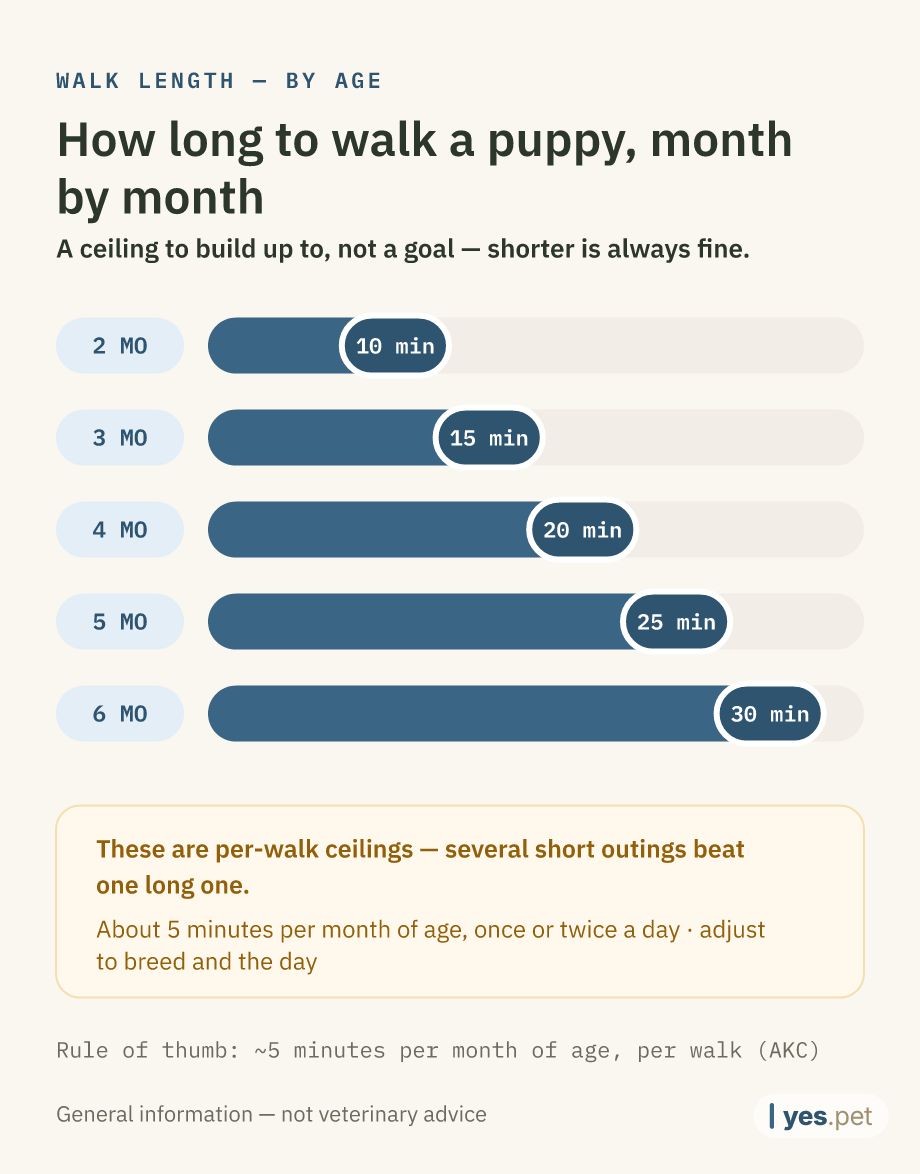
Rough per-walk length by age — a guideline ceiling to build up to, not a goal.
Rule of thumb: ~5 minutes per month of age, per walk (AKC)
When should I talk to a vet?
This is general information, not a health assessment. Ask your veterinarian before increasing activity if your dog tires quickly, limps, seems reluctant to move, is very young or old, or has a known health condition.
Your vet can set a target that fits your dog's specific breed, age and fitness — that always overrides any general rule of thumb.
Rough daily activity orientation by group (not a prescription)
| Group (example breeds) | Typical activity appetite | Planning note |
|---|---|---|
| Herding (German Shepherd, Border Collie, Australian Shepherd) | High — sustained daily activity | Add mental work, not just distance |
| Sporting (Labrador, Golden Retriever, Vizsla, Pointer) | High — "regular, invigorating exercise" | Vary terrain and pace |
| Companion / lower-energy | Lower — shorter outings | Quality over length |
| Flat-faced (brachycephalic) | Often shorter, gentler | Watch heat and breathing; ask your vet |
| Puppies (any group) | Short and frequent | ≈5 min per month of age, 1–2× a day |
Key takeaway
Base daily exercise on your dog's age, health and breed group rather than one universal number; use the five-minutes-per-month rule of thumb for puppies, and let your veterinarian set the right target for your dog.
Turn this advice into a schedule →
Frequently asked questions
How much exercise does my dog need each day?
It depends on age, health and breed: higher-energy breeds need considerably more than lower-energy ones, and there is no single universal number. Start from a baseline for your dog's group and age, then adjust to how your dog copes and ask your vet.
How much exercise does a puppy need?
A common rule of thumb is about five minutes of walking per month of age, once or twice a day, with high-impact activity like jogging held off until the puppy is more mature. Build up gradually and adjust to your puppy.
Is this a substitute for veterinary advice?
No. yes.pet provides general information only and is not a substitute for professional veterinary advice, diagnosis or treatment. Always consult your veterinarian.
Sources
- How Much Exercise Does a Dog Need Every Day? (opens in a new tab) — American Kennel Club (AKC)
- How Much Exercise Does a Puppy Need? Mental and Physical Exercises (opens in a new tab) — American Kennel Club (AKC)
- Sporting Group (opens in a new tab) — American Kennel Club (AKC)
- List of Breeds by Group (opens in a new tab) — American Kennel Club (AKC)