How long can dogs hold their bladder? By age, size and day vs night
Last reviewed: 2026-07-09 · General information only.
For puppies, a widely-shared rule of thumb is that they can comfortably hold it for about their age in months plus one, in hours — so a 3-month-old puppy has a maximum window of roughly 4 hours. That ceiling applies to a calm, settled puppy, and it is not a target interval for potty breaks: an active puppy needs to go out more often than that. It is general orientation only — every dog is different, and your veterinarian knows yours best.
What is the maximum a dog can hold it?
For a puppy, the simplest starting point is the "months plus one" rule of thumb for the maximum comfortable window between breaks.
The American Kennel Club puts it this way: "Take the age of your puppy in months and add one, and that is the maximum number of hours that your puppy should be able to comfortably hold it between potty breaks." [src]
So an 8-week (2-month) puppy maxes out around three hours, a 3-month-old around four, and so on. Treat that as a ceiling for how long a calm, settled puppy can comfortably hold it — not a target interval for potty breaks. Bladder control is still developing, and a resting dog holds longer than an active one; an active puppy needs to go out more often. For how often to actually offer breaks (the trigger moments), see our companion guide on puppy potty frequency.
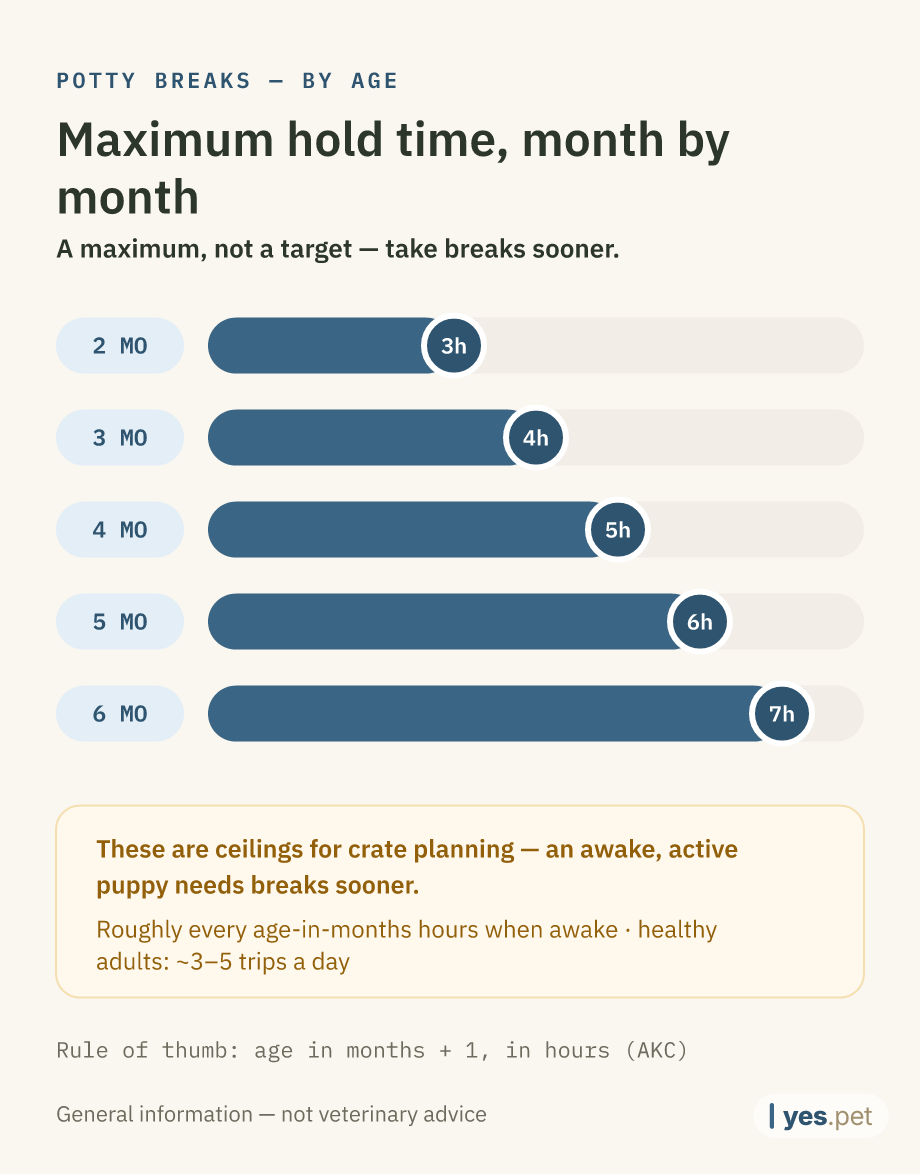
Maximum time between potty breaks by age — a ceiling for a calm, settled puppy, not a break schedule.
Rule of thumb: age in months + 1, in hours (AKC)
Does body size change how long a dog can hold it?
Body size affects bladder capacity more than breed label does. A smaller dog has less to work with, so it is often offered breaks more often than a large dog of the same age.
The AKC notes that "puppies drink more water, have smaller bladders, and pee more often, while older dogs may become incontinent." [src]
Breed alone is not the deciding factor, though: the AKC says "the dog's breed should not make a difference in the amount of urination unless that breed is predisposed to renal (kidney) issues," and that "under usual circumstances, healthy adult dogs need to relieve themselves three to five times a day." [src]
So read "size" as bladder capacity, not as a strict breed rule — a small adult is often more comfortable with more frequent breaks, while a larger adult may stretch the window a little.
Why can a dog hold it longer at night?
Most dogs can last longer asleep than they can during an active daytime stretch, because a resting body produces urine more slowly and there is no excitement or extra drinking driving the need.
The AKC observes that puppies "will usually be able to hold their bladder for a longer period when they're asleep and not active." [src]
That is why the overnight window often closes before the daytime one — a young puppy may sleep through before it can reliably go the same number of hours awake.
When should I talk to a vet?
This is general information, not a health assessment. Ask your veterinarian if your dog suddenly needs to go far more often, seems unable to hold a previously comfortable window, strains, or has accidents that are out of character.
A change in how long your dog can hold it can simply be development or age — or it can be a reason for a check. Your vet can tell the difference, and that always overrides any general rule of thumb.
Rough comfortable window — age, size and awake vs asleep (orientation only)
| Factor | Rough effect on the window | Notes |
|---|---|---|
| 8-week (2-mo) puppy | ~3 hours max | "Months + 1" rule is a ceiling, not a break schedule; offer breaks every 1–2h when awake |
| 3-month puppy | ~4 hours max | Maximum hold (calm, settled); offer breaks every ~3h when active |
| 5-month puppy | ~6 hours max | Growing control; keep regular breaks |
| Smaller body / smaller bladder | Often shorter window | Offer breaks a bit more often |
| Larger body | Often a little longer | Still keep a routine, not just maximums |
| Asleep vs awake | Usually longer asleep | Resting body, no extra drinking or excitement |
| Adult dog | Longer overall | ~3–5 toilet trips a day under usual conditions |
| Senior dog | May be shorter | Ask your vet if it changes |
Key takeaway
Use the "age in months plus one" hours rule as a rough ceiling for how long a calm, settled puppy can hold it — not as a break interval. When active, offer breaks more often: roughly every age-in-months hours (without the +1). Expect smaller dogs to want breaks a bit more often, and most dogs to hold longer asleep than awake. For how often to offer breaks day-to-day, see our potty-frequency guide.
Turn this advice into a schedule →
Frequently asked questions
How long can a dog hold its pee?
For puppies, a common rule of thumb is about their age in months plus one, in hours, so a 3-month-old is roughly a 4-hour window. Body size and day-vs-night also matter: smaller dogs often want breaks a bit more often, and most dogs can hold longer asleep than awake. Use it as orientation and adjust to your dog.
Do small dogs need to pee more often than big dogs?
Size affects bladder capacity, so a smaller dog has less to work with and is often offered breaks a little more often than a larger one of the same age. Breed by itself is not the deciding factor, and healthy adult dogs typically need three to five toilet trips a day. Ask your vet about your specific dog.
Is this a substitute for veterinary advice?
No. yes.pet provides general information only and is not a substitute for professional veterinary advice, diagnosis or treatment. Always consult your veterinarian.
Sources
- Puppy Potty Training Schedule: A Timeline for Housebreaking Your Puppy (opens in a new tab) — American Kennel Club (AKC)
- Why Is My Dog Peeing So Much? Urinary Frequency in Dogs (opens in a new tab) — American Kennel Club (AKC)