How long can a puppy stay in a crate? What the guidance says — and where it disagrees
Last reviewed: 2026-08-20 · General information only.
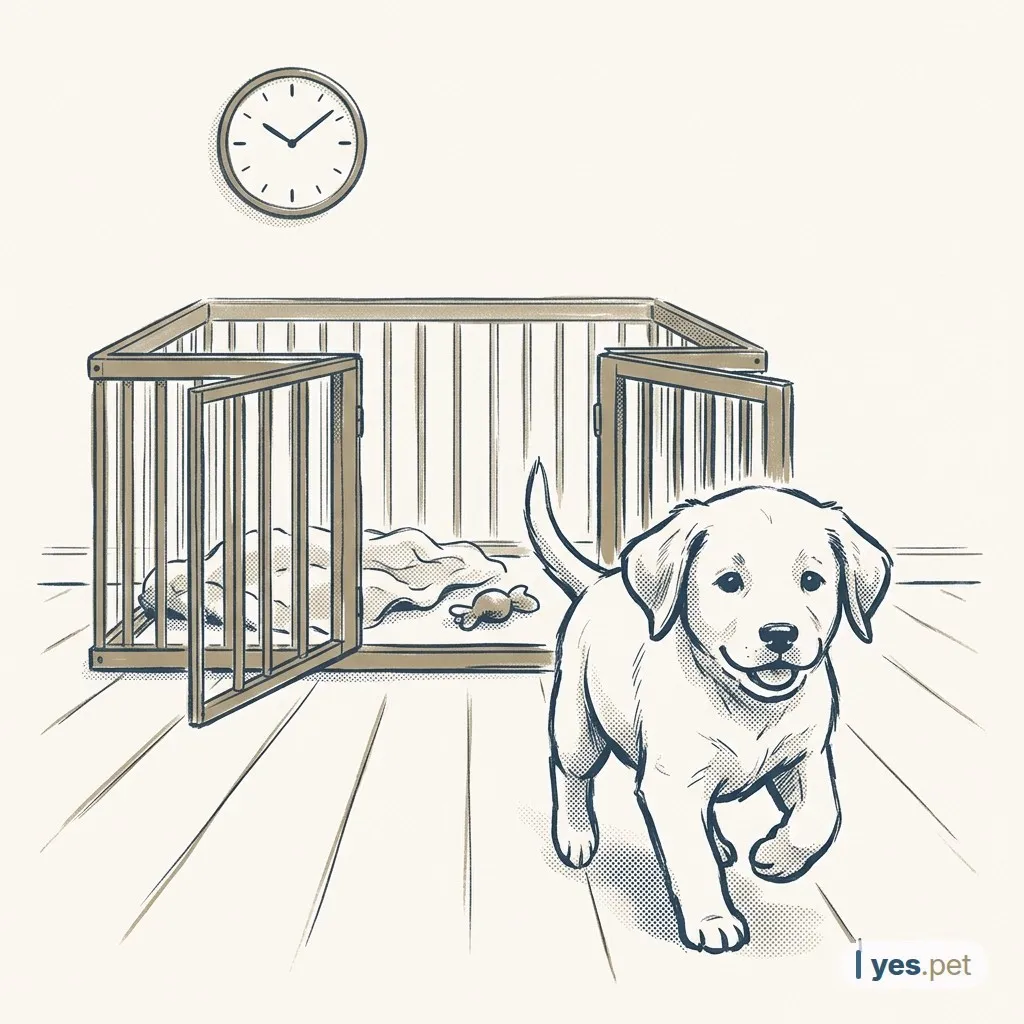
The largest US organization advises no more than three or four hours at a stretch for a puppy under six months, while UK guidance caps it at three. For adult dogs the two come apart further — four to five hours during the day against about three — and neither side is quoting the other. Every one of those numbers measures the same thing, how long the confinement lasts, and none of them measures how long a puppy can hold its bladder. This is general orientation only, and your veterinarian knows your dog best.
What is the short answer?
Three or four hours at a time for a puppy under six months. That is the figure the largest US organization publishes; the UK organizations that publish one give three hours, and one of them attaches no age qualifier to it at all.
Humane World for Animals (formerly the Humane Society of the United States) states that "puppies under 6 months of age shouldn't stay in a crate for more than three or four hours at a time," and that adult dogs "shouldn't be left in a crate for more than 4-5 hours during the day." [src]
The UK figures are lower and are written as a limit rather than as advice: PDSA says that "dog crates should never be used as punishment or for longer than three hours at a time." [src]
The RSPCA arrives at the same three hours for adult dogs, but says it in softer terms than PDSA — its three hours describe a dog that is comfortable, not a rule that is broken: adult dogs are "normally quite happy to be left for about three hours." Its prohibition is a separate sentence, and it is about the working day: "it's never acceptable to shut your dog in the crate all day while you go to work." [src]
So the honest answer to "how long" is a range with a border running through it: about four to five hours for an adult on the American reading, about three on the British one. We show the gap rather than average it away, because the two sets of numbers describe the same thing and the organizations behind them plainly judge it differently.
One thing they do agree on, and it is the part most often lost: every figure above is a ceiling on time in confinement — how long the door stays shut. It is not a measure of how long a puppy can comfortably hold its bladder. Those are two different quantities that happen to be counted in the same unit, and our companion guide on bladder control covers the second one; this page is about the first.
None of these figures is a target. Less time behind a closed door is better whenever the day allows, and an open door is better still. In some countries, including Sweden, welfare rules go further and forbid closing the crate door for routine use entirely. See the law section below for what several countries actually regulate.
Why the hours are only half the answer
A number on its own cannot tell you whether a given afternoon was acceptable — and the sources do not even agree that a number is the right instrument. The American and British organizations answer in hours: bound the stretch, and end it on a plan rather than whenever someone gets home. The Swedish and German authorities address a more fundamental question. For them the issue is not how many hours the door stays shut but whether it is shut at all, and this page will not pretend those are one position. Hours are the floor of this subject, not the consensus of it.
That is why "how long can a puppy stay in a crate" turns, on inspection, into a scheduling question. Three hours with a planned break at the end of it and three hours that happen to end when you return are the same number and not the same thing. The first is a limit you set; the second is a limit you discovered.
It is also the part an owner can actually act on. You cannot make a puppy's bladder bigger, and you cannot make the guidance agree with itself. You can decide in advance when the next break falls — which is what our potty schedule generator helps map out for a puppy's age.
The guidance doesn't agree with itself
Anyone who reads more than one source on this topic runs into the same formula twice — age in months, plus one, in hours — attached to two different quantities. The number is identical either way, so the label is the only thing telling you what you are looking at. It is worth being precise about who attaches which.
Humane World for Animals presents the formula as a limit on crate time: puppies "need more frequent breaks and shouldn't be crated longer than their age in months plus one hour." [src]
The American Kennel Club presents the same formula as a limit on the bladder: "puppies can only hold their bladder for a number of hours equal to their age in months, plus one." [src]
On a second page the AKC drops the extra hour altogether, writing that "dogs can control their bladders for the number of hours corresponding to their age in months." [src]
There is also a contradiction inside a single page. The Humane World article that caps puppies under six months at three or four hours at a time is the same article that offers age-in-months-plus-one as a crate ceiling — and for a four-month-old, that formula returns five hours, past a cap printed a few lines away.
British organizations sidestep the formula entirely. They publish neither reading of it, and answer a different question instead — not how long a puppy can last, but how often it should be taken out.
The RSPCA, after listing the moments a puppy should be taken out, adds a standing interval: "then every 45 minutes to an hour, depending on the puppy's age." [src]
PDSA sets it wider: "take your puppy out every 2-3 hours during the day." [src]
Battersea gives a similarly tight interval: "puppies need far more toilet breaks than adult dogs – often every hour at first." [src]
Those three figures are a third quantity, and keeping it apart from the other two matters just as much. How often a puppy is offered a trip outside is not how long it can hold on, and it is certainly not how long a door may stay shut. Read the RSPCA's forty-five minutes as a crate ceiling and you would conclude something no British organization says; read PDSA's two to three hours as a bladder maximum and you would be quoting a toilet routine as physiology. They are quoted here to show what each organization chose to measure, not as this page's schedule.
There is a reason those organizations have no formula to offer, and it is visible in how they phrase the interval.
The Royal Kennel Club ties the interval straight to the puppy's development rather than to a clock: "puppies have very poor bladder control, and need to urinate at least every hour or two." [src]
That is a statement about bladder control — the second quantity, not the third — used to explain how often the puppy goes out. The British approach derives the routine from the physiology and stops there; it never turns the physiology into a number of its own, and so never produces something that could be mistaken for a permitted length of confinement. The American approach names the number, and that is precisely where the contradiction arises.
Three quantities have now been quoted on this page, all counted in hours, all describing different things:
- How long the door may stay shut — Humane World's three or four hours for a puppy under six months, and PDSA's three.
- How long the bladder holds — the AKC's age in months plus one, and the Royal Kennel Club's "very poor bladder control".
- How often the puppy is taken out — the RSPCA's forty-five minutes to an hour, PDSA's two to three hours, Battersea's every hour at first.
Because the two American readings share a formula, it is tempting to frame the confusion as a matter of getting the direction wrong. It is simpler than that. Applied exactly as Humane World intends it — as a ceiling on crate time — the formula overtakes Humane World's own cap: five hours for a four-month-old against a printed maximum of three or four. The contradiction is not in how the rule is read, but in the rule itself.
So when a stated ceiling and the formula disagree, which governs? The ceiling. It is an absolute limit that does not move, while the formula is an estimate that grows by an hour every month — so the formula is the one that eventually walks past it. That is also why every figure on this page is given with the quantity it measures and the organization it came from.
What the law says — Europe and Japan
Rules differ enough by country that a single sentence about "the law" would be wrong almost everywhere — and that includes any sentence beginning "in Europe". Of the six countries below, three regulate this, two do not address it in national law, and the sixth regulates the opposite thing. What none of them does is ban crates as items.
Sweden. Under the Swedish Board of Agriculture's rules on keeping dogs and cats (SJVFS 2020:8, 2 kap. 1 §), a dog's freedom of movement may not be restricted except in listed situations. The agency itself calls this the "burförbudet" — the crate prohibition — and states the consequence plainly in its inspection checklist: "you can let the dog use a crate as a sleeping place, but you must then never close the door of the crate," and the dog "shall be able to go in and out of the crate as it wishes." [src]
The same agency addresses crate training directly, and does not endorse it: training a dog in order to improve its welfare during transport "can be a justified reason" for keeping it briefly in a smaller space, but "the Swedish Board of Agriculture does not, however, consider the above to be a suitable training method." Its example of doing it well is a transport box with the door removed. [src]
Finland. The line the Finnish Food Authority draws is temporary versus not: the space requirements for a dog cage apply, it says, in cases where a dog is kept in a cage "muutoin kuin tilapäisesti" — other than temporarily. [src]
Those requirements sit under the Animal Welfare Act (Laki eläinten hyvinvoinnista 693/2023), in force since the start of 2024. [src]
Germany. The dog-keeping ordinance (TierSchHuV) never uses the word crate. It works through § 5 Abs. 2, which sends the reader to the floor areas in § 6 Abs. 2 — 6, 8 or 10 square meters depending on the dog's height at the shoulder — and through the term "Raumeinheiten", added in 2021 to widen the scope beyond rooms. [src]
The legislator's own explanatory note says what that widening was for: the requirements apply also to "movable room units (such as boxes and other containers)", and "room units, such as transport boxes, that do not meet the requirements are unsuitable for the keeping of dogs." [src]
How a German supervisory authority reads that is the sharpest statement in this section, and it is worth flagging as an authority's interpretation rather than the letter of the rule: the Bavarian State Office (LGL) writes that "for learning house-training or for addressing behavioural problems, the use of the box is neither suitable nor proportionate" — while adding that boxes "can be sensible retreats, for example when the animals themselves can decide when to seek them out or leave them again." [src]
France. There is no national rule about crates for dogs. The relevant chapter of the Code rural requires that an animal be kept "in conditions compatible with the biological requirements of its species", and the word "cage" in that chapter belongs to a different animal entirely — laying hens, under art. L214-11. [src]
Spain. Also no national rule about crates for dogs; animal-welfare law there is partly regional, and this covers the national act. Ley 7/2023 does mention cages, but addresses them to species that "by their characteristics and species live permanently in cages, aquariums, terrariums and the like" — which dogs do not. [src]
Japan. Numerical cage dimensions exist, but they bind licensed animal-handling businesses, not households. [src]
The standard that does apply to private owners — the Standards Relating to the Care and Keeping of Household Animals — contains no cage provision at all. What its dog chapter regulates is the opposite axis: it discourages letting a dog roam free, and asks owners to "endeavour to secure the amount of exercise necessary to maintain the dog's health." [src]
That last one is worth stating clearly, because "no rule" and "a rule pointing the other way" are not the same finding. In Japan the private owner's duty is framed around movement the dog must get, not around a container it may be kept in.
Those six do not add up to one pattern, and it would be careless to claim they did. In the three places that regulate this at all — Sweden, Finland, Germany — what is regulated is the regime rather than the object: whether the door is shut, whether the use is temporary, how much floor there is. In France and Spain the national acts simply do not address it, and an absent rule says nothing in either direction. Japan is the third case again: there is a rule, and it faces the other way, toward the exercise the dog is owed.
If you use a crate, what makes the confinement "limited"?
Plenty of owners use a crate, and nothing above says they should not. What the sources ask for is easier to satisfy than it first looks, because the figures are not really about the hours; they are about two properties of the arrangement.
Two properties the figures and rules above are actually describing:
- A time limit set before the confinement starts, not one worked out after the fact — a stretch you decided on, with an end you already know.
- A release that is scheduled rather than incidental — the break happens because it was due, not because someone happened to come home.
Two, not three, and the omission is deliberate. It is natural to want supervision on that list — somebody in the house, somebody within earshot — and the organizations quoted here do not put it there. The RSPCA names the working day as unacceptable without saying what makes it so, and we are not going to supply the reason on its behalf. Time and release are what the sources actually state, so those are what this page claims.
A third property shows up wherever an authority describes the arrangement approvingly, and it is the one that removes the question altogether: the dog decides when to go in and when to come out. Both authorities quoted in the previous section reach for that same picture — an open door, or no door — when they describe what a good setup looks like.
Dogs Trust publishes no hourly figure at all — it points owners to their own vet or a qualified behaviorist — and shifts the emphasis to a different piece of equipment: "playpens can be more appropriate than crates for use at night." [src]
A puppy-proofed room works on the same open-door principle: a doorway blocked by an exercise-pen panel instead of a shut door, nothing chewable or dangerous within reach, and the puppy free to move between resting and exploring. Neither a playpen nor a puppy-proofed room replaces supervision, but both remove the single variable — a door the puppy cannot open — that every ceiling on this page exists to limit.
Two situations sit outside all of this, and they are named by the rules themselves rather than being exceptions we invented: transport, and confinement on veterinary instructions. Swedish practice even has a word for the second one — burvila, crate rest — for the weeks of restricted movement a vet may prescribe after an operation or an injury. Those are decisions for a professional, not for a schedule.
For everything else, the practical move is unglamorous: write the day's crate openings down as part of your routine. A puppy's day has a small number of predictable moments when it needs to go out, and putting them on paper turns a vague worry into a short question — when is the next opening? Our potty schedule generator builds that list for a puppy's age.
Two limits then apply at once, and the shorter one wins. The schedule says when the next break is due; the crate ceiling — three or four hours for a puppy under six months, on the figure quoted at the top of this page — is an absolute limit that does not stretch to meet it. If a schedule asks a five-month-old to wait five hours, the ceiling of three or four is the one that forces the break. So the stretch does not simply run until the next scheduled break. It runs until the next break or until the ceiling, whichever arrives sooner. The schedule can never stretch past the ceiling.
When should I talk to a vet?
This is general information, not a health assessment. Ask your veterinarian if your puppy is distressed by being confined at all, cannot settle, or shows a sudden change in how often it needs to go out.
A vet is also the right person to ask before any period of restricted movement during veterinary care, and before making a change if your dog's routine has to include long stretches alone. Your vet knows your dog, and that always overrides a general rule of thumb — including every figure on this page.
What each organization and rule actually states about time in a crate — and how strictly
| Organization or rule (country) | What the source states, and how strictly | What it is about |
|---|---|---|
| Humane World for Animals (US) | Three or four hours at a time, puppies under six months | Time the door stays shut |
| Humane World for Animals (US) | Four to five hours during the day, adult dogs | Time the door stays shut |
| PDSA (UK) | Never longer than three hours at a time — a prohibition, and the crate is not to be used as punishment either | Time the door stays shut |
| RSPCA (UK) | About three hours for an adult dog — an orientation about the dog being comfortable, not a prohibition. The prohibition is separate: shutting a dog in all day while you are out at work is never acceptable | Time the door stays shut |
| Dogs Trust (UK) | No figure given; owners are pointed to their vet or a behaviorist | Not stated as a number |
| Jordbruksverket, SJVFS 2020:8 (Sweden) | No hours at home — the door is never to be closed | Whether the door is shut at all |
| Ruokavirasto, Act 693/2023 (Finland) | No hours — use other than temporarily brings in the cage space requirements | Whether the use is temporary |
| TierSchHuV and LGL Bayern (Germany) | No hours — floor areas of 6, 8 or 10 square meters, which no household crate meets | Space rather than time |
| France, Spain | Nothing at national level — the national acts do not address crates for dogs | No national rule applies |
| Japan | Nothing at national level about crates for private owners; cage dimensions bind licensed animal-handling businesses only. The household standard instead asks owners to secure the exercise the dog's health needs | The dog's movement — a duty pointing at release, not at containment |
Key takeaway
Every published figure — on the US reading, three or four hours for a young puppy and four to five for an adult; on the UK one, three — is a ceiling on time in confinement: not a measure of how long the bladder holds, and not a recommended routine for how often the puppy goes out. Those are three different quantities, and the same "age in months plus one" formula is published as two of them by different organizations. The sources do not converge on a single rule, and the gap is the useful part: the American and British organizations limit the hours, while the Swedish and German authorities question the closed door itself. What they all treat as the deciding fact is when the dog gets out. Deciding those openings in advance is the part you control — and a schedule never stretches past a stated ceiling.
Turn this advice into a schedule →
Frequently asked questions
How long can a puppy stay in a crate?
Humane World for Animals puts puppies under six months at no more than three or four hours at a time, and adult dogs at four to five hours during the day. UK organizations publish lower figures: PDSA says never longer than three hours at a time, and the RSPCA says it is never acceptable to shut a dog in a crate all day while you are at work. All of those numbers measure time in confinement, not bladder capacity, and they are general orientation — ask your vet about your own dog.
Is the "age in months plus one hour" rule about crate time or about the bladder?
It depends entirely on who is writing. Humane World for Animals uses it as a limit on crate time; the American Kennel Club uses the same formula as a limit on how long a puppy can hold its bladder, and on another of its own pages drops the extra hour. British organizations do not use the formula at all. Because both readings are in circulation, the number is only meaningful with the quantity named alongside it.
Are crates illegal in Europe?
None of the jurisdictions reviewed on this page bans crates as objects. What is regulated is the regime. Sweden's agriculture board treats shutting the door at home as a restriction of the dog's freedom of movement and says the door should never be closed; Finland's rules turn on whether the use is temporary; Germany's ordinance works through floor areas that a household crate cannot meet. France, Spain and Japan have no national rule about crates for private owners at all. Transport and veterinary situations are named as exceptions in the rules themselves.
What if I have to be out for a full working day?
That is the situation the guidance is most explicit about: the RSPCA says it is never acceptable to shut a dog in a crate all day while you are at work. The practical question becomes who opens the door and when — a neighbor, a walker, a midday visit — rather than how long the confinement can be extended. Dogs Trust also suggests a playpen can be more appropriate than a crate in some settings. Ask your vet or a qualified behaviorist about your own dog's routine.
Does crate size affect how long a puppy can stay in it?
Size affects comfort more than it changes the hourly ceiling, but a cramped crate makes any stretch harder on a puppy, making it crucial to get right. Humane World for Animals says a crate should be large enough for a dog to stand up and turn around in, noting that adjustable crates that grow with a puppy work well. PDSA is more specific: it must be tall enough for the dog to stand and sit without touching the top, and wide and long enough to turn around, lie down, wag its tail, and stretch out fully — adding that too big is better than too small. A roomier crate does not extend the time limits discussed on this page — and a crate too small to meet those standards should not be used at all: switch to a bigger crate, a playpen or a puppy-proofed room, and always size up as your puppy grows. This is a general guideline only — a breeder, trainer, or your vet can advise on the right size for your puppy.
My puppy whines or cries in the crate — what does that mean?
Treat it as a signal, not defiance. When a puppy shows signs of distress like whining or scratching, PDSA advises going back to an earlier stage of training to rebuild confidence, rather than pushing through. Humane World for Animals notes that at night it can be hard to tell whether whining means "let me out" or "I need to go outside," but is direct on one point: never punish a dog for whining. If the crying is frequent, does not settle, or is accompanied by pacing, drooling, or damage to the crate, it points to distress rather than a routine request. In these cases, a playpen or a puppy-proofed room may suit that puppy better than a closed crate. Talk to your vet or a qualified behaviorist if the whining persists; this is general orientation, not a diagnosis.
Is this a substitute for veterinary advice?
No. yes.pet provides general information only and is not a substitute for professional veterinary advice, diagnosis or treatment. Always consult your veterinarian.
Sources
- Crate training 101 (opens in a new tab) — Humane World for Animals (formerly the Humane Society of the United States)
- Potty Training Puppy Tips (opens in a new tab) — American Kennel Club (AKC)
- How to Potty Train a Puppy (opens in a new tab) — American Kennel Club (AKC)
- Crate training (opens in a new tab) — PDSA (People's Dispensary for Sick Animals, UK)
- Dog crates (opens in a new tab) — RSPCA (UK)
- Toilet training your dog (opens in a new tab) — RSPCA (UK)
- Toilet training your puppy (opens in a new tab) — PDSA (People's Dispensary for Sick Animals, UK)
- How do I toilet train my dog? (opens in a new tab) — The Royal Kennel Club (UK)
- How to toilet train a puppy or dog (opens in a new tab) — Battersea (UK)
- Crate training (opens in a new tab) — Dogs Trust (UK)
- Bilaga till checklista – Sällskapsdjur (dnr 5.2.17-21134/2022) (opens in a new tab) — Jordbruksverket (Swedish Board of Agriculture)
- Bilaga till checklista – Hund (dnr 5.2.12-01071/2024) (opens in a new tab) — Jordbruksverket (Swedish Board of Agriculture)
- Usein kysyttyä eläinsuojelusta (opens in a new tab) — Ruokavirasto (Finnish Food Authority)
- Laki eläinten hyvinvoinnista 693/2023 (opens in a new tab) — Finlex (Finnish legislation)
- Tierschutz-Hundeverordnung (TierSchHuV) (opens in a new tab) — Gesetze im Internet (German Federal Ministry of Justice)
- Bundesrat-Drucksache 394/21 — explanatory note to the 2021 amendment (opens in a new tab) — Bundesrat (Germany)
- Tierschutzwidriges Zubehör am Beispiel der Hundeboxen (opens in a new tab) — Bayerisches Landesamt für Gesundheit und Lebensmittelsicherheit (LGL)
- Code rural et de la pêche maritime, art. L214-1 ff. (opens in a new tab) — Légifrance (France)
- Ley 7/2023, de 28 de marzo, de protección de los derechos y el bienestar de los animales (opens in a new tab) — Boletín Oficial del Estado (Spain)
- 令和三年環境省令第七号 — cage dimensions for licensed animal-handling businesses (opens in a new tab) — e-Gov (Government of Japan)
- 家庭動物等の飼養及び保管に関する基準 (Standards Relating to the Care and Keeping of Household Animals) (opens in a new tab) — Ministry of the Environment (Japan)