Puppy potty schedule by age — a simple potty training routine
Last reviewed: 2026-08-20 · General information only.
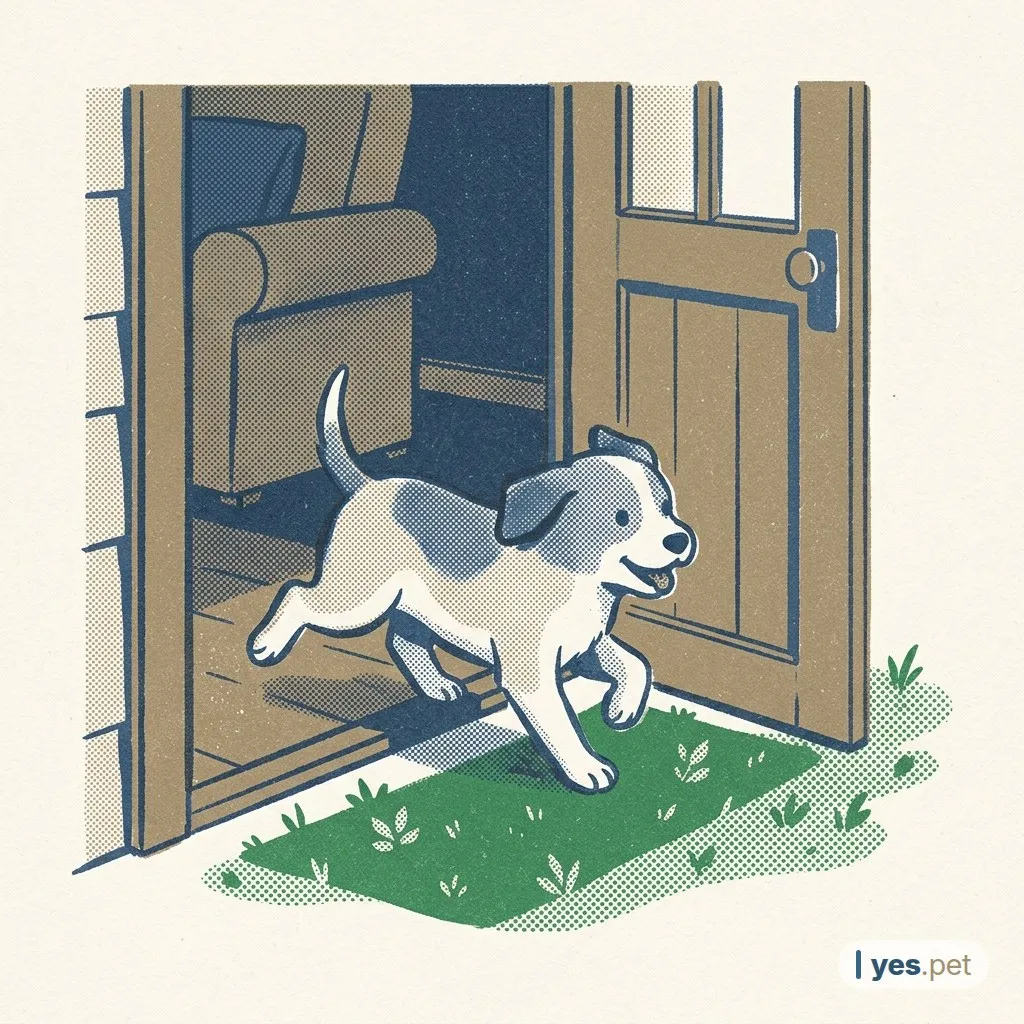
A good potty routine is built on trigger events, not the clock: take your puppy out after every wake-up, meal, drink and play session, plus roughly every hour or two in between while awake. This guide turns those triggers into a simple potty training schedule by age, including a sample daily routine and a rough count of breaks per day. It is general orientation only — every puppy is different, and your veterinarian knows yours best.
What is a good potty training schedule for a puppy?
A successful potty training schedule relies on trigger events rather than the clock: a young puppy almost always needs to go after waking up, after meals, after drinking and after play — and usually every hour or two in between while awake.
The American Kennel Club lists the key trigger moments: take the puppy out first thing when "the alarm clock goes off"; "after the meal, only wait between 5 and 30 minutes to take your puppy outside"; treat drinking water "just like a meal, and take them out to potty soon afterward"; and watch for "periods after naps and playtime." [src]
If you want to know how long a puppy can comfortably hold it between those breaks (the "age in months plus one" hours idea), see our companion guide on how long dogs can hold their bladder.
What does a sample daily potty schedule look like?
Once you understand these trigger moments, you can build a rough daily timeline. A typical day for a young puppy might include breaks first thing in the morning, right after breakfast, mid-morning, after any big drink or play session, right after lunch, mid-afternoon, right after dinner, after evening playtime, and just before bed — plus one or more overnight trips for the youngest puppies.
Feeding on a schedule makes the rest of the day easier to predict: "Feed your puppy on a schedule. If you control when your puppy eats, you can better predict when they'll have to go to the bathroom." [src]
Because every household's wake-up time, work hours and feeding schedule differ, a generic list of clock times won't fit everyone perfectly. Our free Puppy Potty Schedule Generator turns your puppy's age and daily routine into a personalized schedule.
How many potty breaks a day by age?
Frequency is highest when a puppy is young and tapers as they grow and gain bladder control — which forms the backbone of the schedule above. The table below is a rough count of how many times a day you might offer a break, anchored to those wake / meal / drink / play moments rather than fixed clock times.
For context on the adult end of the scale, the AKC notes that "under usual circumstances, healthy adult dogs need to relieve themselves three to five times a day." [src]
Anchor potty trips to those predictable moments rather than relying on the clock alone — it is both easier to remember and kinder while a puppy is still learning.
How long does it take to potty train a puppy?
Most puppies take a few months to become reliably potty trained. The exact timeline depends on the individual puppy, their breed size, and how consistently you follow a schedule. Smaller breeds often take longer because they have smaller bladders.
If training begins early, "a 6-month-old puppy is usually able to be depended on most of the time to eliminate outside," according to AKC Chief Veterinarian Dr. Jerry Klein. [src]
This is a general guideline, not a guarantee. Progress can be slower if you skip training steps, keep an inconsistent schedule, or if the puppy has an underlying medical issue. If your puppy is well past six months old with little progress, mention it at your next vet visit.
Should puppy pads be part of the schedule?
Pads can be a reasonable part of your schedule in certain situations — such as apartment living without easy outdoor access, owners with limited mobility, or for a puppy that isn't fully vaccinated and can't safely go outside yet.
As the AKC puts it, "training pads can sometimes play a role in successful potty training" in situations like these — and if you plan to move outdoors eventually, "move the potty pad outside" and "only move it a small distance each day so you don't confuse your puppy." [src]
Pads work best as a deliberate part of the schedule, not a fallback for missed trigger moments. Inconsistently mixing indoor and outdoor options tends to slow potty training down rather than speed it up.
When should I talk to a vet?
This is general information, not a health assessment. Ask your veterinarian if your puppy suddenly needs to go far more often than before, strains, has accidents long after you expected reliability, or shows any sign of discomfort.
Your vet can tell whether a change in frequency is just normal development or something that needs a check — that always overrides any general rule of thumb.
Rough potty schedule by age (anchor to wake / meal / drink / play)
| Puppy age | ≈ Potty breaks per day | Always go after… |
|---|---|---|
| 8 weeks (~2 mo) | Many (often 8–10+) | Every wake, meal, drink and play; ~1–2h otherwise |
| 3 months | Frequent | Every wake, meal, drink and play; ~2h otherwise |
| 4 months | Fewer | Every wake, meal and play; a few times in between |
| 5 months | Fewer still | Every wake, meal and play; a few times in between |
| 6 months | Settling toward a routine | Wake, meals and play; usually more dependable |
Key takeaway
Build your puppy's potty schedule around trigger events — after every wake, meal, drink and play, plus roughly every hour or two in between while awake. Let the number of breaks drop naturally as your puppy matures. You can use our free schedule generator to turn those triggers into specific times for your day. Ask your veterinarian about any sudden changes, including a previously reliable puppy having accidents again. For how long a puppy can hold it between breaks, see our bladder guide.
Turn this advice into a schedule →
Frequently asked questions
What is a good puppy potty schedule by age?
Very young puppies usually need a break after every wake-up, meal, drink and play session, plus roughly every hour or two in between while awake — often eight to ten or more trips a day at first. As your puppy grows, this schedule will naturally stretch out. For how long a puppy can comfortably hold it between breaks, see our bladder guide.
What are the main times I should take my puppy out?
The reliable trigger moments are first thing after waking, shortly after each meal, soon after drinking water, and after play or naps. Taking your puppy out at those moments catches most needs without watching the clock. Adjust to your puppy and ask your vet if unsure.
Why did my potty-trained puppy start having accidents again?
Often called potty training regression, this is common during growth spurts, adolescence (which can start around six months), or following a change in routine, environment, or stress. Go back to basics for a while: tighten up the schedule, supervise more closely, and reward successful trips outside. As VCA Animal Hospitals notes, "if your previously well-trained dog begins house soiling, always consult your veterinarian for guidance — there could be a medical condition or behavioral condition causing this change."
Is this a substitute for veterinary advice?
No. yes.pet provides general information only and is not a substitute for professional veterinary advice, diagnosis or treatment. Always consult your veterinarian.
Sources
- Puppy Potty Training Schedule: A Timeline for Housebreaking Your Puppy (opens in a new tab) — American Kennel Club (AKC)
- Why Is My Dog Peeing So Much? Urinary Frequency in Dogs (opens in a new tab) — American Kennel Club (AKC)
- The Ins and Outs of Potty Pad Training (opens in a new tab) — American Kennel Club (AKC)
- House Training Your Puppy (opens in a new tab) — VCA Animal Hospitals