GDV (Bloat) in Dogs: Symptoms, Risk Breeds, and How to Prevent It
Last reviewed: 2026-07-09 · General information only.
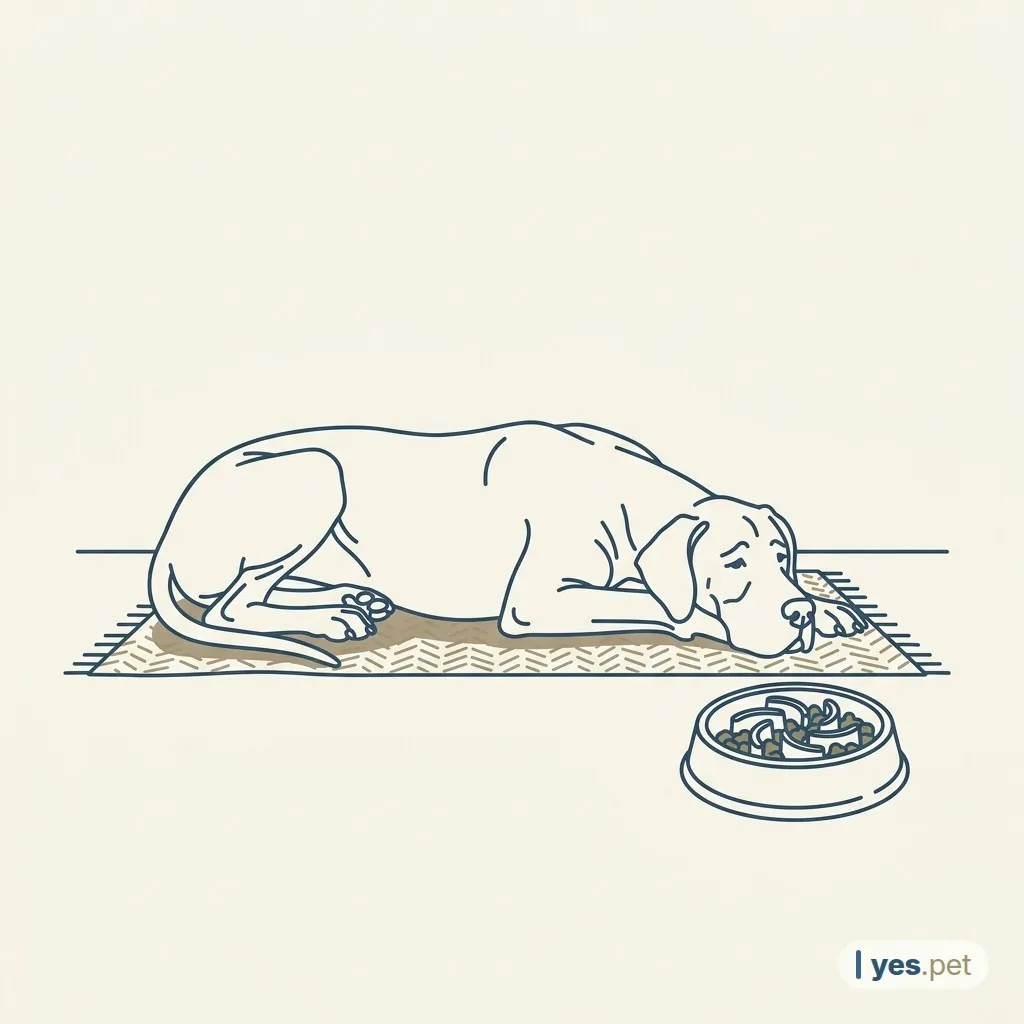
Gastric Dilatation-Volvulus — commonly called bloat or GDV — is one of the fastest-moving emergencies in veterinary medicine. A dog's stomach fills with gas, then twists on itself. Once twisted, blood flow to vital organs is cut off and time becomes the most critical factor in survival. Without emergency surgery, GDV is almost always fatal within one to two hours of onset. Understanding the warning signs, knowing which dogs are most at risk, and following a few simple prevention rules can make the difference between life and death.
What is GDV?
GDV is a two-stage process. First, the stomach distends — it fills abnormally with gas, fluid, or food. Second, and most critically, the distended stomach rotates on its axis, sometimes 180 to 360 degrees. This rotation, called volvulus or torsion, traps the stomach contents, compresses blood vessels, and cuts off circulation to the stomach wall and spleen.
Once torsion occurs, the stomach wall begins to die. Toxins flood the bloodstream. Cardiac arrhythmias develop. The dog goes into shock. There is no way for the body to untwist the stomach on its own.
VCA Animal Hospitals describes it directly: "GDV is a life-threatening emergency. Even with prompt, optimal treatment, the death rate is still high." [src]
This is not a 'let's see how he feels in the morning' situation. It is a call-the-emergency-clinic-right-now situation.
Which breeds are at highest risk?
GDV overwhelmingly affects large and giant breeds with deep, narrow chests. A deep chest gives the stomach more room to move and rotate freely. Smaller dogs can get simple bloat (without the twist), but full GDV with volvulus is statistically rare outside the large and giant size categories.
The AKC notes that 'large-breed and giant-breed dogs with deep chests' are most susceptible, citing Great Danes, Saint Bernards, Weimaraners, Irish Setters, Gordon Setters, Standard Poodles, Basset Hounds, Doberman Pinschers, and Old English Sheepdogs among the highest-risk breeds. [src]
Some studies estimate more than 40 percent of Great Danes will experience GDV in their lifetime — the highest rate of any breed. [src]
Other factors that amplify breed risk include: a first-degree relative (parent or sibling) that had GDV, lean or underweight body condition, anxious or fearful temperament, and advancing age.
Smaller and toy breeds are not immune to gastric distension, but the full GDV emergency with stomach rotation is rare enough in them that the specific prevention protocols described here are primarily targeted at large and giant breeds.
Why vigorous activity after meals is a trigger
When a dog eats, the stomach fills and expands. The ligaments that normally hold the stomach in place are stretched by the added weight. A gas-filled, food-heavy stomach has more mass and more mobility than an empty one — it behaves like a weighted pendulum, easier to swing and flip during a sudden turn or jump.
Vigorous physical activity right after eating — running, jumping, rough play — creates the movement that can cause that rotation to happen. This is the physiological mechanism behind the 'no vigorous exercise after meals' recommendation.
VCA Animal Hospitals recommends waiting at least one hour before and after meals before allowing vigorous exercise. [src]
Low-intensity calm walking is generally considered acceptable — it is vigorous running, jumping, and rough activity that carries the risk. The safest pattern for large and giant breeds is calm activity before meals, a rest period, and then a calm walk an hour or more after eating.
This timing applies in both directions: exercise before a large meal on an empty stomach can also predispose the stomach to gas accumulation and movement.
Prevention: what actually works
No prevention strategy eliminates GDV risk entirely, but these measures are consistently supported across veterinary sources.
Feed two or three smaller meals per day instead of one large meal. A smaller stomach is a more stable stomach. Single large feedings are one of the most consistently cited risk factors in the literature.
Slow the eating. Dogs that eat quickly swallow large amounts of air, which directly contributes to gastric distension. Slow-feeder bowls, puzzle feeders, and snuffle mats all work. Even spreading kibble across a wide, flat surface helps.
Keep the food bowl on the floor. The elevated food bowl, long promoted as a prevention measure, has been shown to increase GDV risk in large and giant breeds. The AKC now advises against elevated feeders unless a veterinarian has a specific medical reason — such as megaesophagus — to recommend one. [src]
Ask your veterinarian about prophylactic gastropexy — a surgical procedure that permanently anchors the stomach to the abdominal wall so it cannot rotate. It can be performed during a routine spay or neuter surgery. For Great Danes and other very high-risk breeds, many veterinarians recommend discussing it proactively. It does not prevent simple bloat (distension without torsion), but it prevents the fatal torsion component.
Keep the feeding environment calm. Stress and anxiety at mealtime are associated with higher GDV risk. If your dog is competitive or anxious around other dogs at feeding time, feed separately.
Warning signs — act immediately if you see these
GDV typically comes on suddenly, progresses quickly, and does not improve on its own. The following signs are cause for immediate emergency veterinary contact.
The most hallmark sign is unproductive retching — the dog makes repeated attempts to vomit but produces little or nothing. Combined with a visibly swollen or distended abdomen, this combination is a near-certain indicator of GDV until proven otherwise.
Other signs include: restlessness and inability to get comfortable, excessive drooling or foamy saliva, a hunched posture with reluctance to move, rapid or labored breathing, and pale or white gums (a late-stage sign indicating shock).
The MSD Veterinary Manual notes that affected dogs are 'acutely distressed and may attempt to vomit unproductively' and that 'the condition deteriorates rapidly.' [src]
A simple upset stomach improves. GDV does not — the symptoms worsen with every passing minute. If you see unproductive retching and a swollen belly in a large or deep-chested dog, treat it as an emergency until a veterinarian tells you otherwise.
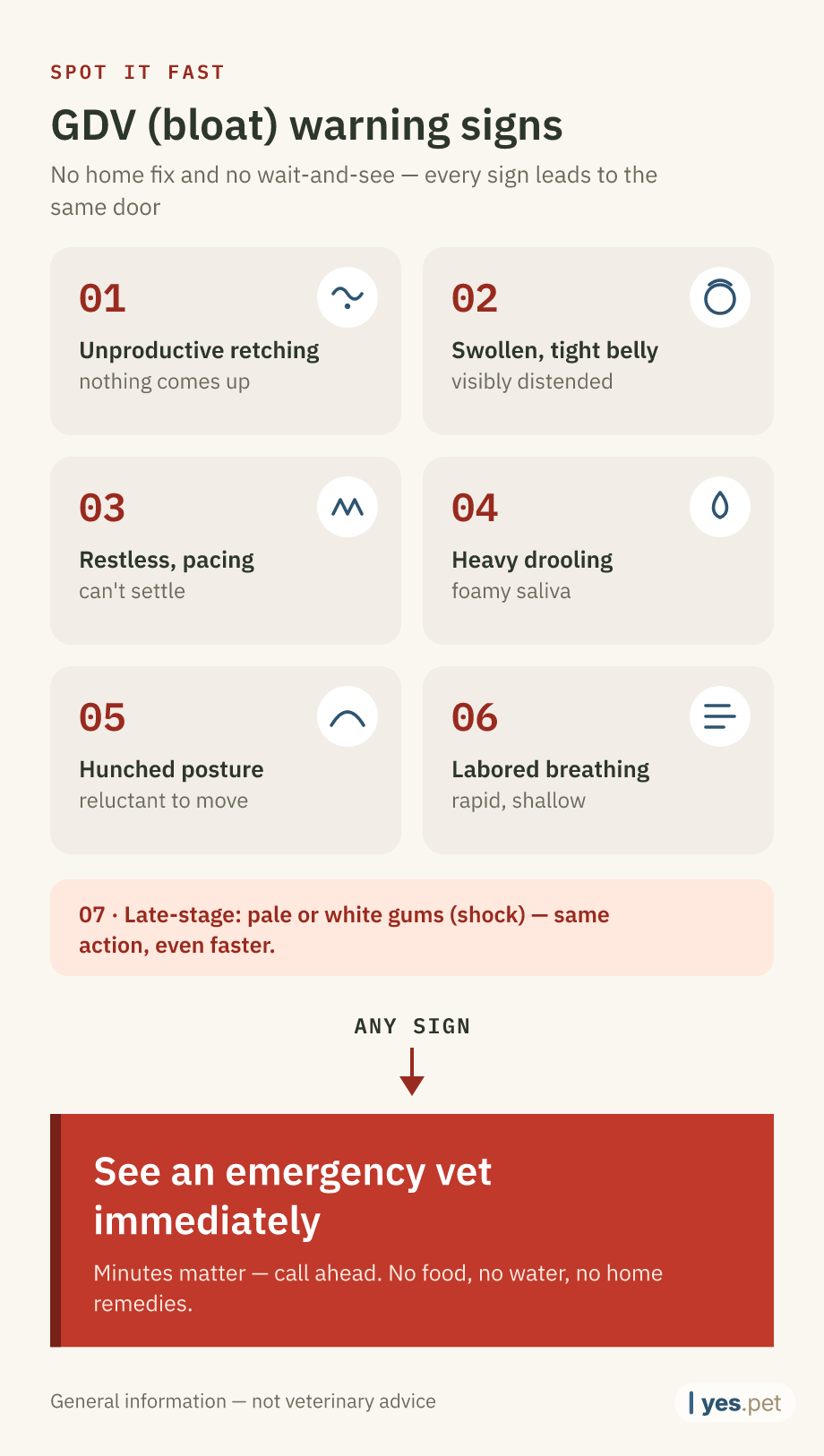
ANY SIGN
See an emergency vet immediately
Minutes matter — call ahead. No food, no water, no home remedies.
Bloat (GDV) warning signs in dogs — every sign resolves to the same action: emergency vet, immediately.
What to do if you suspect GDV
Call your nearest emergency veterinary clinic immediately — do not wait to see if symptoms improve. Call ahead so the clinic can prepare for an emergency patient on arrival.
Do not give food, water, antacids, or any medications. Do not attempt to relieve gas manually. Keep the dog as calm as possible and limit movement during transport.
Survival rates with prompt surgery are above 80 percent in most studies. When the stomach wall has begun to die from prolonged torsion, mortality rises sharply even with surgery. [src]
This is general information, not a substitute for veterinary advice. If you have a high-risk breed, talk to your veterinarian about your dog's individual risk profile and whether prophylactic gastropexy makes sense — ideally before an emergency arises.
Turn this advice into a schedule →
Frequently asked questions
Is GDV always fatal without surgery?
Without emergency surgery, GDV is almost always fatal within one to two hours of onset. There is no home treatment that can untwist a stomach. Call an emergency veterinary clinic immediately if you suspect GDV.
Can I take my dog for a short walk right after eating?
A slow, low-intensity walk is generally considered lower risk than vigorous activity. It is running, jumping, and rough play immediately after a large meal that are most closely linked to GDV. For large and giant breeds, the general guidance is to allow at least one hour of rest after meals before any energetic activity. Ask your veterinarian for advice specific to your dog's breed and risk profile.
Does raising the food bowl help prevent bloat?
No — and it may make things worse. Research has found that elevated food bowls are associated with a higher risk of GDV in large and giant breeds, reversing older conventional advice. Keep the bowl on the floor unless your veterinarian has a specific medical reason to recommend elevation.
Should I ask my vet about gastropexy for my large breed dog?
Prophylactic gastropexy — a surgery that anchors the stomach to prevent rotation — is worth discussing with your veterinarian if you own a high-risk breed such as a Great Dane, Weimaraner, or Doberman. It can be performed during a routine spay or neuter. This is general information only; your veterinarian can advise whether it is appropriate for your individual dog.