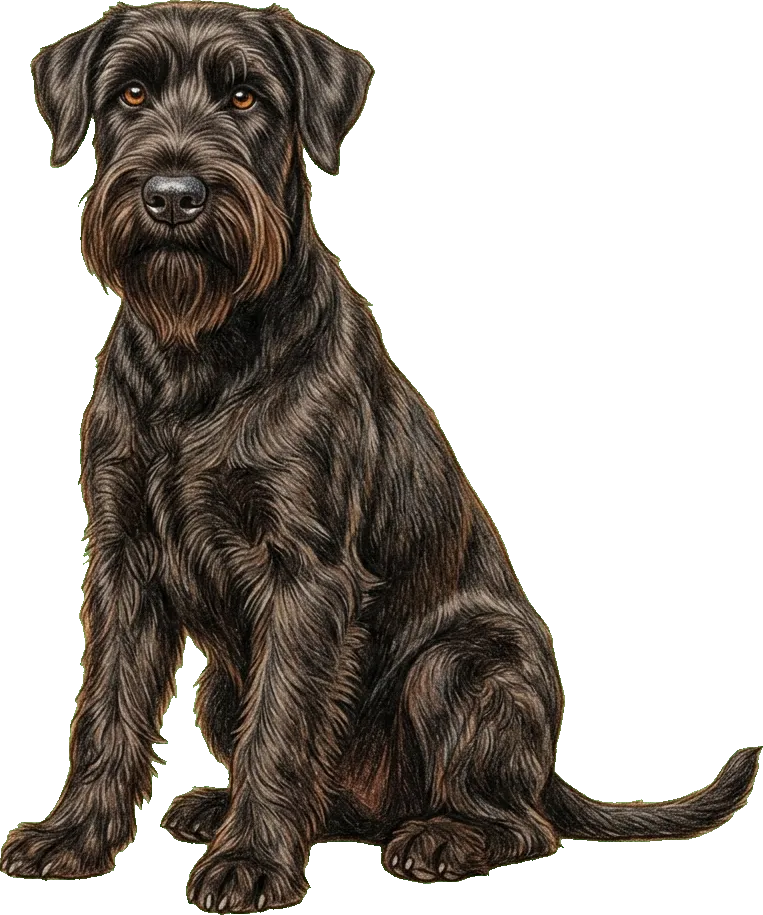
Giant Schnauzer
The Giant Schnauzer is a powerful, highly intelligent working breed that thrives when it has a real job, firm-but-fair guidance, and close involvement in family life. This guide covers the daily commitment behind that impressive dog: demanding exercise and mental work, consistent training from an experienced hand, and the regular coat care its wiry double coat requires.
Daily-care planners
House-training
Easy to house-trainGiant Schnauzers are bright and quick to learn, which usually makes house-training straightforward. A young Giant grows fast and needs frequent, predictable trips outside paired with immediate praise for every success. The main pitfall is the puppy's energy and curiosity indoors, so a crate routine and close supervision during the early weeks keep things on track.
Walks
High exercise needsThis is an athletic working breed with real stamina, and a single stroll rarely satisfies it. Aim for vigorous daily exercise — brisk walks, jogging, fetch, or structured training — plus problem-solving games that engage the mind. A well-fitted harness and reliable leash skills matter, because a strong, driven dog can be a handful without them. The dense double coat gives good cold tolerance but only moderate heat tolerance, so ease off during hot, humid spells and carry water. Above all, a Giant Schnauzer wants to work alongside its person; pairing exercise with training turns a walk into the purposeful activity this breed lives for.
Plan walksTemperament
Developed in the Bavarian countryside to drive cattle and later to guard property and serve in police and military roles, the Giant Schnauzer pairs real physical power with a fast, problem-solving mind. With its own family it is affectionate, playful, and deeply loyal, often shadowing its people from room to room.
This is a natural guardian breed — reserved with strangers and alert to anything out of place. Early, ongoing socialization and reward-based training channel that watchfulness into steady, discerning behavior rather than suspicion. The Giant learns quickly, but its intelligence and drive call for a consistent owner who can provide leadership and a genuine outlet, whether obedience, tracking, protection sports, or another demanding activity.
A bored or under-exercised Giant will invent its own projects, so daily physical exercise and mental challenge are non-negotiable. With other dogs it can be selective, particularly with the same sex, and its size and energy mean play with young children should be supervised. Given structure, exercise, and companionship, it becomes a devoted, dependable partner that is more than a match for an active household.
What life with a Giant Schnauzer asks of you
Grooming & coat
- Grooming effort
- High grooming
- Shedding
- Seasonal shedding
- Coat
- Medium coat
Exercise & enrichment
- Daily exercise
- High exercise needs
- Mental stimulation
- High mental stimulation
- Trainability
- Balanced
Temperament & sociability
- With people
- Reserved with strangers
- With dogs
- Selective with other dogs
- With kids
- Good with considerate children (supervise)
- Barking / noise
- Moderately vocal
- Chase instinct
- Moderate prey drive
- Time alone
- Moderate separation-anxiety risk
Home & climate fit
- Hot weather
- Moderate heat tolerance
- Cold weather
- High cold tolerance
- House-training
- Easy to house-train