Brussels Griffon
The Brussels Griffon is a tiny Belgian breed with an outsized personality, originally bred to hunt rats in Brussels stables before becoming a devoted companion for city apartments. Living well with one means matching its big, curious, sometimes self-important character with gentle, consistent training, close daily companionship, and attentive care for its expressive eyes, compact jaw, and (in the rough-coated variety) a coat that needs regular hand-stripping. A little dog with a lot to say, it thrives when its comfort — physical and emotional — stays the whole point of the routine.
Daily-care planners
House-training
Challenging to house-trainHouse-training a Brussels Griffon takes real patience: a small bladder, an independent streak, and a strong dislike of cold or wet weather all work against a fast routine. Frequent, scheduled trips outside, warm praise for every success, and covered or sheltered potty spots for bad weather move things along far more reliably than any correction.
Walks
Moderate exercise needsA Brussels Griffon's main walking limits are size and heat, not stamina — a couple of short daily outings, plus indoor play, comfortably covers its moderate exercise needs. Its short muzzle makes hot or humid weather riskier than it looks, so favor cool mornings and evenings and treat heavy panting as a cue to head in. A well-fitted harness is gentler than a collar for such a small neck, and building calm leash manners early is much easier with a toy-sized puppy than a set-in-its-ways adult. Consistency, not distance, is what makes these walks work.
Plan walksTemperament
Developed in the stable yards of Brussels to hunt rats before being refined into a lap companion, the Brussels Griffon carries an outsized, self-assured presence in a tiny body. Owners often describe the breed as having "enough personality for ten ordinary dogs" — alert, inquisitive, and endlessly expressive, especially through its almost human-like face.
That confidence comes paired with real sensitivity. Griffons bond intensely with their people, earning a reputation as a "Velcro dog" that prefers being close by rather than off exploring alone, and they can be reserved or easily put off by strangers, loud households, or rough handling. Patient, reward-based training suits them far better than correction, since a Griffon that feels pushed around tends to become more guarded rather than more obedient. They can also be a touch independent-minded, so consistency and short, engaging sessions work better than repetition alone.
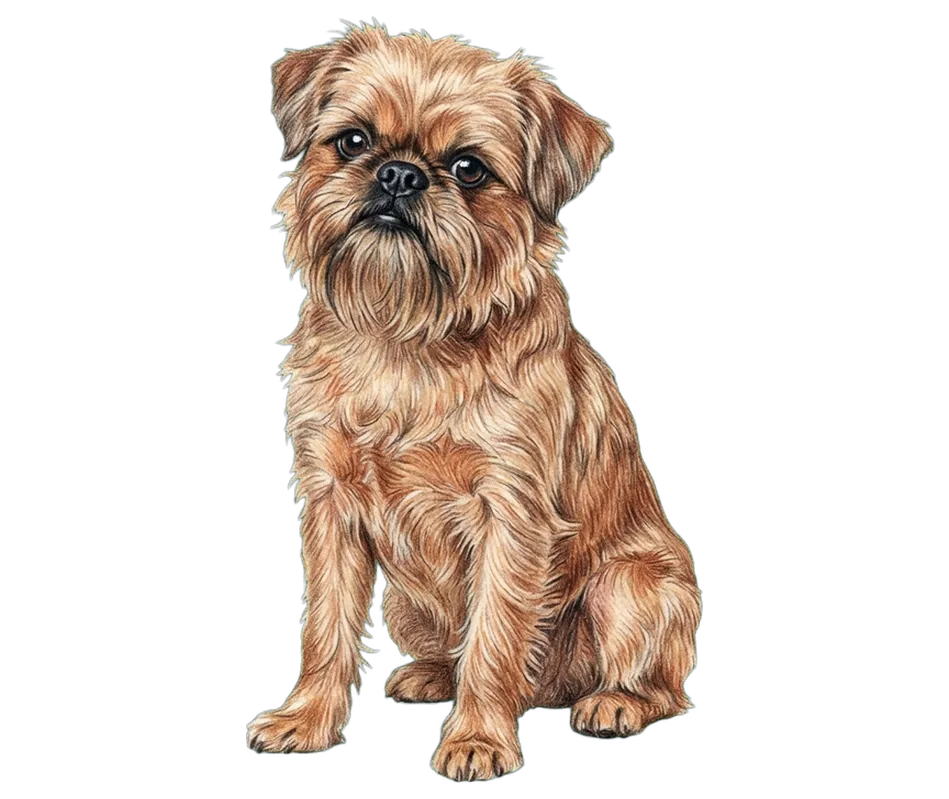
The breed comes in two coat varieties that share a personality but not a grooming routine: a wiry, rough coat that does not shed but needs hand-stripping every few weeks to stay healthy, and a smooth, short coat (sometimes called the Petit Brabançon) that sheds moderately and needs only regular brushing. Either way, their large, prominent eyes and compact, slightly undershot jaw call for gentle daily attention — a quick face and eye check, along with dental care, prevents small issues from building up.
Exercise needs are moderate rather than minimal: a couple of short walks or play sessions a day keep a Griffon fit and settled, though its short muzzle and small size make it genuinely heat-sensitive, so warm-weather activity belongs in the cool parts of the day. With children, supervised, gentle interaction works best — the dog's small, somewhat delicate build and sensitivity to rough play make them a better match for calm households or older kids than for toddlers. Around other dogs, thoughtful introductions help, since a Griffon can be selective about canine company and still carries a trace of its ratting-era prey drive around small animals.
What life with a Brussels Griffon asks of you
Grooming & coat
- Grooming effort
- High grooming
- Shedding
- Minimal shedding
- Coat
- Short coat
Exercise & enrichment
- Daily exercise
- Moderate exercise needs
- Mental stimulation
- Moderate mental stimulation
- Trainability
- Independent thinker
Temperament & sociability
- With people
- Politely friendly
- With dogs
- Selective with other dogs
- With kids
- Good with considerate children (supervise)
- Barking / noise
- Moderately vocal
- Chase instinct
- Moderate prey drive
- Time alone
- High separation-anxiety risk
Home & climate fit
- Hot weather
- Low heat tolerance
- Cold weather
- Low cold tolerance
- House-training
- Challenging to house-train